Vol. 21 · Published Nov 18, 2026 · Book + Claude skill + MCP
The Prompt Systems Playbook
Get the Same Good Result From AI on Monday and on Tuesday
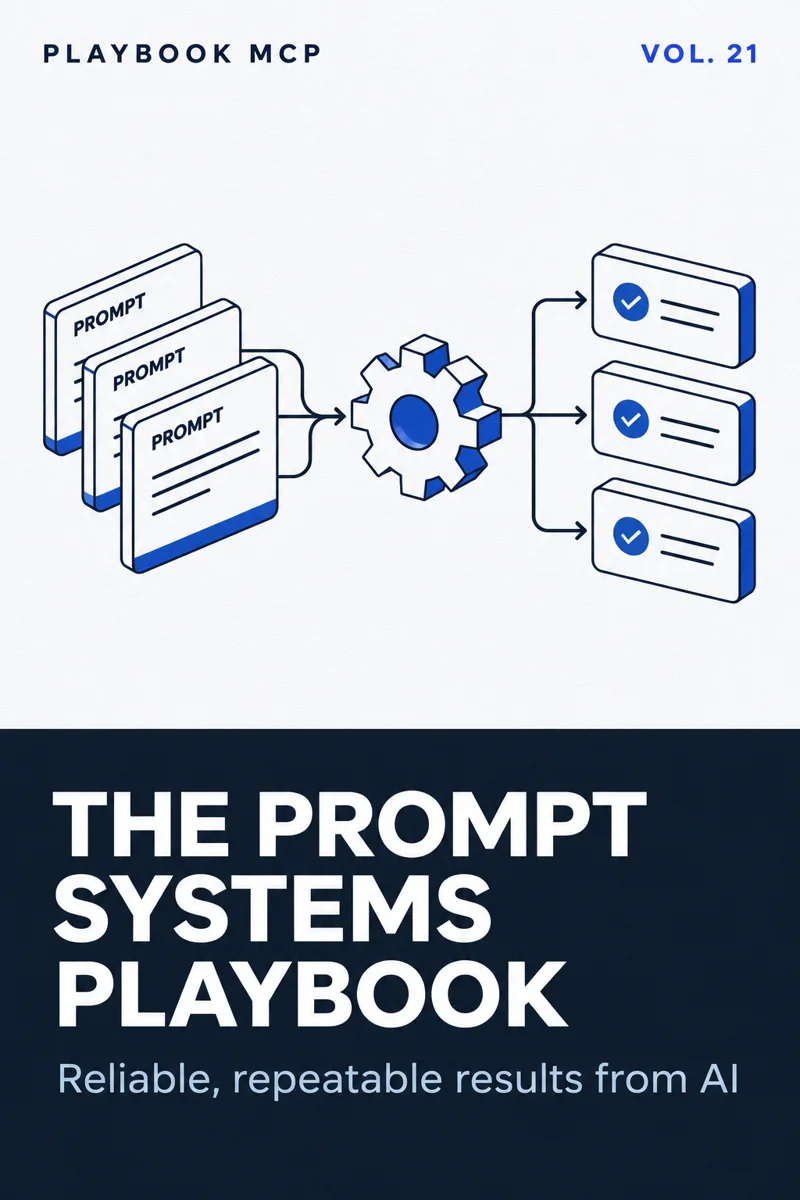
About this playbook
Reliable, repeatable results from AI
Most variation in AI output is not randomness; it is open decisions the prompt never made. This playbook separates the four causes of variance (sampling, ambiguity, context drift and model changes) and gives each its own fix, based on what Anthropic, OpenAI and Google document and on clearly labeled working practice.
A nine-step method takes one recurring task from a five-run variance diagnosis through a structured spec, examples and a rubric, a fixed output contract, decomposition and an evaluation set to a versioned template library, agent instructions and prompt records. It includes a main prompt, 15 focused prompts and a no-code path for every step. It does not promise a percentage gain; your own baseline shows what you gained.
Who it's for
- Experienced professionals who already use AI and want results they can predict
- Teams that need a colleague to get the same output from the same prompt
- Anyone feeding AI output into a spreadsheet, ticket system or script
- People running coding or research agents that work for hours at a time
- Non-programmers who want a test discipline without writing code
What you'll be able to do
- Run a variance diagnosis and tag every difference by its cause
- Rewrite a loose prompt as a spec with a missing-information rule
- Write a rubric with hard fails and checkable scored criteria, then calibrate it
- Define an output contract or JSON Schema with sorting and unknown-value rules
- Split a mega prompt into a chain of steps with checks between them
- Build a 10-20 case evaluation set and record a baseline pass rate
- Keep tested prompts as versioned templates with an index
- Write agent instructions with a work loop, evidence rules and stop conditions
What's inside
Inside this volume
- 01
Why the same prompt gives different answers
Sampling, ambiguity, context drift and model changes, what usually goes wrong, and the artifacts that make up a prompt system.
- 02
Before you start
Choosing one recurring task, gathering test inputs and good and bad outputs, hard rules, and an intake checklist.
- 03
Diagnose the variance
Five runs in clean contexts, side-by-side comparison, and tagging each difference as open decision, missing information, format or factual error.
- 04
Write a structured spec
Role and goal, inputs, task, constraints, missing-information rule, output format and quality bar, with a before and after example.
- 05
Examples and a rubric
Choosing varied examples, writing hard fails and scored criteria, and calibrating an AI reviewer against its known biases.
- 06
Fix the output contract
Fixed headings for people, schemas for programs, closed vocabularies, evidence rules, deterministic sorting and normalization after the model.
- 07
Decompose the work
Prompt chaining with one verb per step, structured hand-offs, checks between steps and a copy-paste runner without code.
- 08
Evaluation set and regression check
Typical, edge, adversarial and past-failure cases, expected properties, check types and a one-change-at-a-time routine.
- 09
Template library
Template anatomy, fill-in fields, shared blocks, versioning, an index and reusable patterns for creative briefs.
- 10
Agent instructions
Ten sections from mission to reporting format, a prioritization rule, honest limits on what agents can do, and a compact example.
- 11
Prompts as documented assets
A prompt record with owner, model tested on, evaluation result, known limits and change log, plus review and retirement.
- 12
Prompts, checklist, measurement and sources
A main prompt, 15 focused prompts, a full checklist, a measurement table, common mistakes and links to provider documentation.
Use it with your AI agent
Ask for the work. Your agent follows the playbook.
Install the Claude skill or connect the MCP with your license key. Then ask in plain language:
- “Run my current call-summary prompt five times on inputs/call-1.txt in clean contexts, list every difference and tag each by cause. Do not suggest fixes yet.”
- “Propose 15 test cases for this prompt, including adversarial inputs and our past failures, save them to evals/ with expected properties, and report a baseline pass rate.”
- “Review the CLAUDE.md in this repo as a skeptical operator: find missing stop conditions, verification gaps and claimed capabilities our setup does not support, then propose edits.”
Questions
FAQ
Can I make AI output fully deterministic?
No. Providers document that low temperature and seeds help but do not guarantee identical results. The playbook relies on specs, schemas, validation and tests instead.
Do I need to be a programmer?
No. Chapters that mention JSON, schemas or scripts also give a copy-and-paste way to do the same thing. If you do write code, the same artifacts plug into an API call or test.
Does it cover agents, or only single prompts?
Both. A full step covers standing instructions for long-running agents, including a work loop, priorities, evidence requirements, checkpoints and stop rules.
What do I get with the volume?
Each Playbook MCP volume is the book plus a Claude skill and MCP access, so your agent can apply the method one chapter at a time to your own task.
Will it improve my results by a set amount?
It makes no percentage promise. Gains depend on how underspecified your starting prompt was; you measure a baseline first and your evaluation set shows the change.
Better together
The Builder's Codex
Design, build, polish and ship apps with AI agents.
$551 $15.80 Save 97%