NewVol. 44 · Published Nov 26, 2026 · Book + Claude skill + MCP
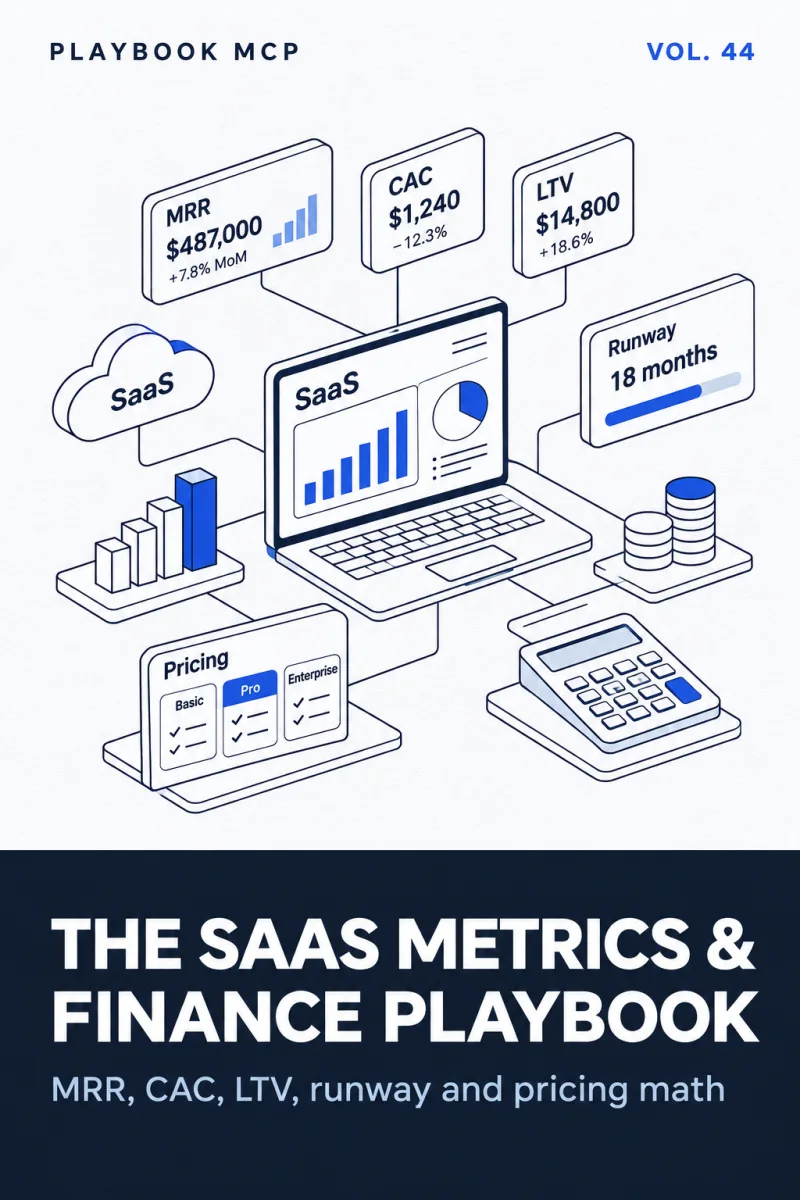
The SaaS Metrics & Finance Playbook
Build SaaS Numbers You Can Trust, Reconciled to Revenue and Cash
$29 $5.80 Save 80%
Instant digital delivery. About 14k words.
About this playbook
MRR, CAC, LTV, runway and pricing math
A SaaS business can grow MRR and still run out of cash. It can report strong net retention while losing most of its small customers. Usually the cause is undefined metrics, mixed-up bookings, billings, revenue and cash, CAC that leaves out salaries, and LTV that ignores margin. The SaaS Metrics & Finance Playbook replaces that with one written method an AI agent can follow using your own billing and accounting data.
You start with a versioned metrics dictionary and a customer-level data spine. From there you build an MRR waterfall that ties to billing, the general ledger and the bank, followed by fixed-cohort retention, gross margin with AI inference included, fully loaded CAC and payback, a capped LTV, a weekly cash forecast and pricing break-even math. It ends with a one-page monthly pack and written decision rules, all worked through with a fictional example company.
Who it's for
- Founders and indie developers at subscription software businesses who need numbers they can act on
- Product and growth leaders deciding what to build, spend and charge
- Finance operators who need MRR, revenue and cash reconciled every month
- Teams with AI features whose inference costs make older margin assumptions wrong
- Anyone preparing to hire, change prices or raise who needs an honest runway and default alive answer
What you'll be able to do
- Write a metrics dictionary with a formula, population, source and owner for every reported number
- Build a customer-month MRR ledger and reconcile it to the billing tool, recognized revenue and cash
- Produce an MRR waterfall and fixed-cohort GRR and NRR that expansion cannot inflate
- Measure gross margin and per-plan contribution at median and tail usage, with AI inference included
- Compute fully loaded CAC, cohort payback and a capped, margin-adjusted LTV
- Forecast cash weekly, find the minimum balance and answer the default alive question
- Calculate break-even churn for price increases and break-even volume for discounts before you change prices
What's inside
Inside this volume
- 01
Write the metrics dictionary
Starting definitions for MRR, ARR, churn, GRR, NRR, CAC, payback, LTV, burn and runway, decision rules for discounts, past_due, trials and usage, and a reviewable policy file.
- 02
Build the data spine and reconcile it
An identity map, a build sequence for monthly snapshots and five reconciliation tests from ledger vs billing tool to processor vs bank.
- 03
MRR waterfall and retention cohorts
Mutually exclusive movement categories, fixed-cohort NRR and GRR formulas, cohort tables, renewal and concentration analysis, and benchmarks with their limits.
- 04
Gross margin and contribution
A COGS classification worksheet, per-plan contribution at median and 95th-percentile usage, and cost per successful outcome for AI features.
- 05
CAC, payback and LTV
Fully loaded blended, paid and incremental CAC, cohort payback, and the rules that keep LTV from growing without limit.
- 06
Cash: burn, runway, default alive, burn multiple
A weekly cash forecast, driver-based scenarios, intervention deadlines and notes on annual prepayments and Section 174A.
- 07
Pricing math and the monthly cadence
Break-even formulas, usage pricing guardrails, a test charter, subscription compliance notes, a close calendar, a one-page pack and decision rules.
Use it with your AI agent
Ask for the work. Your agent follows the playbook.
Install the Claude skill or connect the MCP with your license key. Then ask in plain language:
- “Read these Stripe and accounting exports, build a month-end MRR ledger for the last 12 months, and reconcile it to Stripe's MRR with a list of every difference.”
- “Compute fully loaded blended CAC and cohort payback for Q3 from our ad, payroll and CRM data, and show the inputs you allocated.”
- “Build a 13-week cash forecast with downside, base and action cases, and tell me the lowest balance and the last date to act.”
- “We want to raise the Team plan price by 10%. Calculate break-even churn at our actual contribution margin and draft a pricing memo with a test design and rollback conditions.”
Questions
FAQ
Does the agent change my billing or accounting?
No. The playbook gives the agent read-only access first, including a restricted Stripe key. Changes to billing, prices, accounting entries, payments or customer communications need your explicit approval.
Is this accounting, tax or investment advice?
No. It is practical management information. Anything that goes into filed statements, tax returns, investor documents or customer terms should be approved by a qualified accountant or lawyer.
Does it work with billing tools other than Stripe?
Yes. The method works from exports from Stripe, Paddle, Chargebee or similar tools. Stripe gets the most specific notes, such as how it treats past_due subscriptions and its built-in LTV.
What if I have little billing history?
Publish the periods you have and say clearly what cannot be estimated yet. Start reliable month-end snapshots now, label earlier reconstructions, and hold any decision that a missing field could reverse.
How does it handle usage-based and AI pricing?
You choose explicitly how usage revenue enters your metrics, measure contribution with inference included at median and tail usage, and set allowances and overage prices so heavy users still clear your target margin.





Better together
The Growth Vault
Everything we know about getting users without burning money.
$1,102 $19.80 Save 98%