Vol. 22 · Published Nov 18, 2026 · Book + Claude skill + MCP
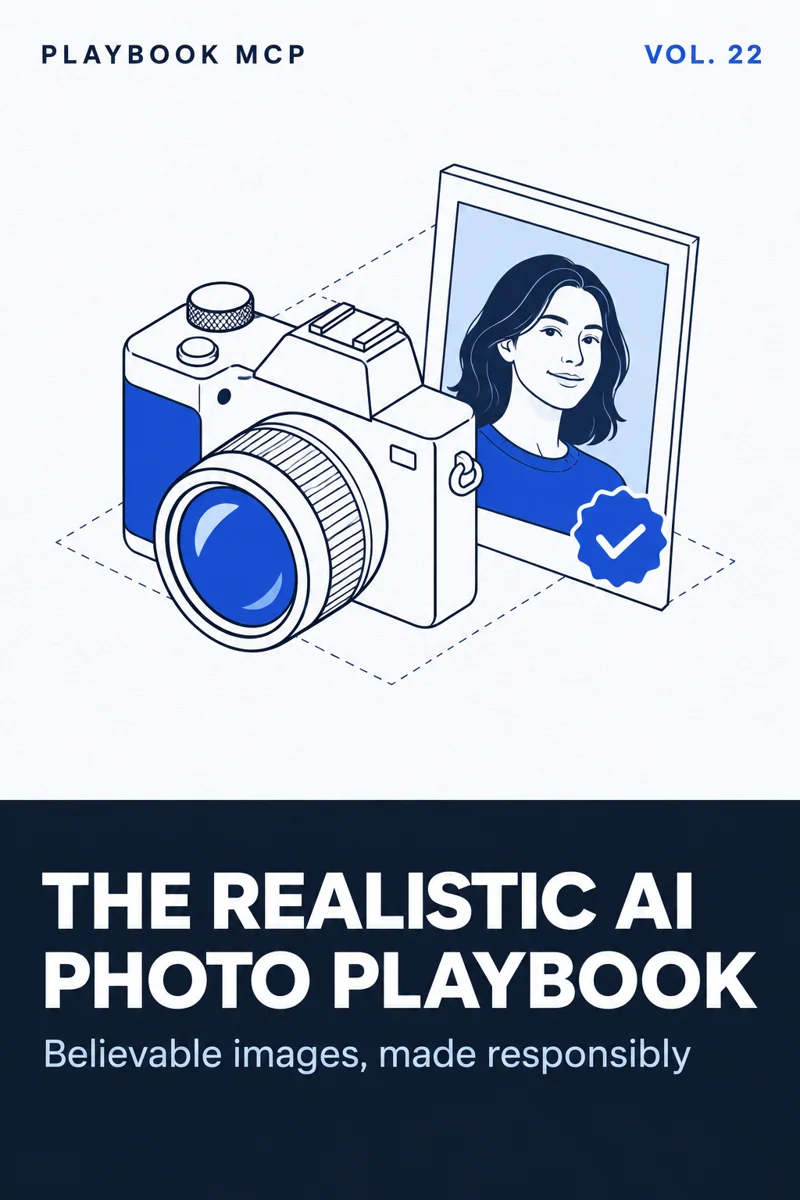
The Realistic AI Photo Playbook
Make Realistic AI Images That Hold Up and Can Be Published Honestly
About this playbook
Believable images, made responsibly
Most AI photos look fake for a few predictable reasons: the scene was never designed as a photograph, detail does not match the camera distance, imperfections are added as decoration, and hands, reflections and identities fall apart across a set. This playbook fixes the causes instead of stacking adjectives, and lets your AI agent do the drafting while you make the calls.
A nine-step method takes you from designing the photograph and choosing a capture type through structured prompts, a style sheet and identity anchor, candidate selection and bounded repairs to finishing, stock licensing, ethics and law, and a three-scale review. It ends with a main prompt, 15 focused prompts and a full checklist. It covers fictional people, consenting models and scenes without people, never real private people without consent.
Who it's for
- Marketers and content teams who need believable lifestyle, product and interior images
- Designers and founders who want a recurring fictional persona that stays consistent
- Writers who need cover images for a series and want to mix AI and licensed stock
- Experienced professionals who want an AI agent to brief, prompt and check while they decide
- Anyone who wants to publish AI images without legal or ethical surprises
What you'll be able to do
- Describe each image by answering five questions about subject, action, photographer, camera and light
- Pick a capture type and know what to inspect for it
- Write structured prompts with positive phrasing and motivated details
- Keep a set consistent with a style sheet and an approved identity anchor
- Select the strongest whole image and repair one bounded defect at a time
- Crop, color and upscale from a clean master and re-inspect after each step
- Source stock photos with a keyword plan and a recorded license for each
- Decide consent, likeness, labeling and provenance for every image before publishing
What's inside
Inside this volume
- 01
Why AI photos look fake
Undesigned scenes, detail that ignores distance, decorative imperfection, broken contact, drifting sets and finishing errors, plus the risks beyond the pixels.
- 02
Before you start
Image list, allowed references, releases, platform rules and an intake checklist.
- 03
Design the photograph
The five questions, vague versus useful instructions, and what makes photos read as real.
- 04
Capture type and treatment
Six capture types with what to inspect, camera language as an appearance cue, and motivated imperfections.
- 05
Structured prompts
A master prompt template, positive phrasing, and eight example prompts from a kitchen coffee scene to a lived-in room.
- 06
Consistency across a set
A style sheet, an identity anchor, a reference pack with assigned roles, and why seeds do not save a person.
- 07
Generate, select and repair
Whole-image selection, bounded repair prompts, a repair-or-restart table, the two-failed-repairs rule and notes per tool family.
- 08
Finishing and upscaling
Clean master, crops per use, restrained color, careful upscaling, export and alt text.
- 09
Stock photos and licenses
When real photos are the better choice, keyword plans, selection rules, Unsplash, Pexels and Pixabay terms, and releases.
- 10
Ethics and law
Consent, right of publicity, fake testimonials, copyright, platform AI labels, the EU AI Act and C2PA content credentials.
- 11
Quality checks and measurement
A three-scale review, a structural checklist at 100 percent, records, and process metrics such as cost per accepted final.
- 12
Prompts, checklist and sources
A step-by-step main prompt, 15 focused prompts, a full checklist, common mistakes and official sources.
Use it with your AI agent
Ask for the work. Your agent follows the playbook.
Install the Claude skill or connect the MCP with your license key. Then ask in plain language:
- “Turn these six landing page image ideas into scene descriptions that answer the five questions, then write a style sheet for the set.”
- “Here are four candidates for the same brief. Evaluate each as a whole image, flag disqualifying contradictions, pick one and write the first bounded repair prompt.”
- “For these 30 blog posts, write a stock keyword plan and selection rule, then build a license record template and flag anything I still need to check.”
Questions
FAQ
Which image tools does it work with?
The method is tool-neutral. It includes notes for OpenAI, Google Gemini, FLUX.2 and Midjourney, and recommends starting with the tool you already have.
Can I make a consistent character across many images?
Yes, for fictional people or consenting models. It shows how to approve an identity anchor, build a three to five image reference pack and compare every new image against the original.
Does it cover legal questions?
It gives practical guidance on consent, likeness, fake testimonials, copyright, platform labels and provenance, and says clearly that it is not legal advice and when to ask a lawyer.
Should I always use AI instead of stock?
No. When an image claims to show something real, such as a real place, product, team or customer, the playbook recommends licensed or own photography.
What do I get with the volume?
Each Playbook MCP volume includes the book, a Claude skill and MCP access, so your agent can apply one chapter at a time to your project.

Better together
The Builder's Codex
Design, build, polish and ship apps with AI agents.
$551 $15.80 Save 97%