Free sample · no email · 2,575 of 15,920 words
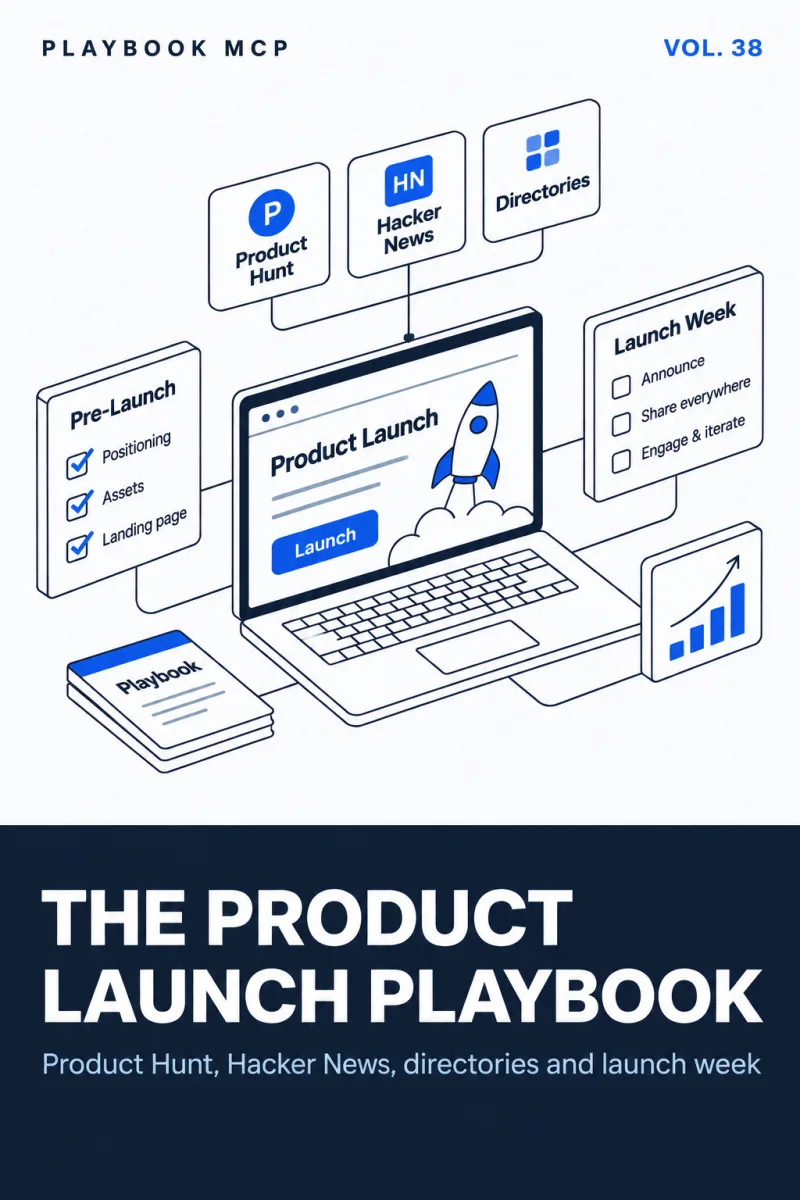
The Product Launch Playbook
The opening of the playbook as your AI agent reads it. The full volume adds the step-by-step playbook, the prompts, the checklist and the sources.
1. The problem
A public event is not an acquisition system. Launch work gets expensive when a team confuses the two. A product page can attract attention while onboarding loses almost everyone. A discussion can produce compliments without reaching buyers. A directory can publish a listing that no relevant prospect ever sees. An announcement can bring existing users back and get counted as new acquisition.
These are different outcomes, so decide which one matters before you choose a platform. Use this chain:
Relevant exposure → product visit → meaningful trial → first value → repeat value → commercial outcome.
Not every product needs every link. A developer library may deliver value at the first successful install. An enterprise product may need a qualified evaluation rather than a checkout. Define the chain for your product. If you don’t, the most visible number becomes the goal by default.
What changed in 2024–2026. A public launch is still one of the cheapest ways for a new product to get its first users, early feedback and a lasting public record. But the main platforms changed, and much of the advice online describes how they used to work.
| Change | Evidence | What to do about it |
|---|---|---|
| Product Hunt replaced “Launch Now” with drafts and scheduling | Help article, 24 February 2025 [6] | Prepare and schedule. Don’t plan around an instant-publish button. |
| Product Hunt ranks by “points”, not raw upvotes. Upvotes, comments, time since launch and other signals count, and votes from established members weigh more than votes from new accounts | Help articles, 1 October 2025 and the launch FAQ [7][16] | Don’t forecast rank from a vote target. Pushing a mailing list to sign up and vote does little, and asking for votes breaks the rules. |
| Homepage featuring is an editorial decision. Unfeatured launches go to the “All” feed | Featuring guidelines, 10 March 2026, and the launch guide [8][9] | Check eligibility and quality before you build a plan that depends on the homepage. |
| Product Hunt retired Coming Soon pages | Changelog [17] | Ignore old teaser-page tutorials. |
| The relaunch window is two months, not the six often quoted | Relaunch guide [15] | Inside two months, file a relaunch request backed by a significant update. |
| Hacker News made its AI rule explicit: no generated or AI-edited comments | HN Guidelines [1] | A launch post that reads as agent-written is a moderation risk and a credibility risk. |
| HN placed temporary restrictions on Show HN submissions because of volume | Notice page [3] | No exact threshold is published. Follow the interface and don’t try to get around it. |
| The FTC rule on consumer reviews and testimonials took effect on 21 October 2024 | FTC Q&A [18] | Fake reviews, incentives tied to sentiment and fake social indicators are now direct legal risks. |
| The UK made fake reviews a banned practice from 6 April 2025. The EU has banned them since 28 May 2022 | [21][22] | The same review rules apply across your main markets. |
| Gmail and Outlook tightened authentication rules for bulk senders. Outlook’s rules were announced in April 2025 and enforced from May 2025 | [29][30] | Authenticate your actual sending domain before you send launch email. |
| UK electronic-mail guidance changed after the Data (Use and Access) Act 2025 | ICO guidance [24] | Re-read the current rules. The new charitable soft opt-in is not a general startup exemption. |
| BetaList now says all submissions are paid | BetaList help [35] | Don’t rely on old free routes. |
Where the sources conflict. Product Hunt’s general overview treats some information products as possible fits [9]. Its dedicated featuring guidelines exclude categories including books, courses, templates and directories [8]. Treat “can I list this?” and “can this be featured?” as separate questions. If your plan depends on the difference, ask the platform before you commit resources.
Directory operators often sell “followed backlinks” as a benefit. Google’s spam policies list low-quality directory and bookmark links, and links built mainly to manipulate rankings, as link spam [25]. A sales promise from a directory does not prove search value. Pay for relevant distribution, not for an assumed ranking gain.
Some disagreements are about strategy, not facts. Launching early gets you learning sooner, but a broad launch exposes onboarding you haven’t fixed. A discount can encourage people to evaluate, but it can also attract buyers your product doesn’t serve. One concentrated launch day is simpler to coordinate. Staggered releases protect support capacity. This playbook recommends a small rehearsal, one primary public launch and a few staggered follow-on channels. Change that when your product, audience or staffing gives you a clear reason.
What usually goes wrong, and why:
| Failure | Why it happens |
|---|---|
| Launch day brings traffic but almost no signups | The product demands a signup before it shows any value, or the first session breaks in a clean browser. Teams test while logged in. |
| Not featured on Product Hunt | The page says what the product is rather than what it does, the edge over alternatives is unclear, or the product sits behind a waitlist [8][9]. |
| A Show HN post sinks | The link goes to a landing page, the post reads like marketing, or nobody is around to answer questions. |
| The launch is flagged or removed | Someone asked for upvotes, ran an upvote contest, posted from a company account or sent mass DMs [13][16]. |
| Launch week ends and the users disappear | No onboarding, no follow-up and no cohort tracking. The launch was treated as the finish line. |
| Nobody knows what worked | No UTM tags, no “How did you hear about us?” field and no goal written down beforehand. |
What good looks like. One written goal, such as “120 activated accounts from launch traffic within 14 days”. A product a stranger can try in a couple of minutes. A positioning line a non-expert understands. Two or three channels that fit the audience, a staffed launch week, and a debrief that turns comments into backlog items. Good launch work leaves four things behind: customers who got value, documented obstacles, reusable distribution assets, and a decision about what to do next that you can defend.
2. Before you start
Create a one-page intake (intake.md). Mark missing answers as unknown. Do not let the agent fill gaps with details that merely sound plausible. Gaps here are the most common reason launches slip or underperform.
Product and audience
- The exact product version or update you are launching
- One primary target user, described in a sentence (“solo bookkeepers who reconcile client invoices in spreadsheets”)
- The situation that makes that user look for help
- The two or three alternatives they use today, including “do nothing” or “a spreadsheet”
- The first useful result a new user should reach (the activation event)
- Supported platforms, regions and languages
- Important limits and features that aren’t available yet
Access and accounts
- Control of the website and the product’s production accounts
- Personal Product Hunt accounts for every maker. Launches and comments come from personal accounts, not company accounts, and submission needs a verified email [10][16]
- A Hacker News account, ideally with a history of real participation
- Accounts on every community you plan to post in, with real participation there. Product Hunt’s own guide warns against dropping links in communities you’ve never posted in [13]
- Directory accounts created and email-verified early. AlternativeTo requires a verified email before you submit [36]
- Admin access to analytics (GA4, Plausible, PostHog or similar), the email platform, billing and support
- A named person who can pause campaigns and disable broken flows
Evidence and measurement
- Signup and activation events defined and firing
- Baseline traffic, activation and paid conversion, where you have them
- A lowercase UTM naming convention
- A “How did you hear about us?” field in signup or onboarding
- Consent status known for every email segment, with records
- Screenshots from the version users will actually get, a short demo video, a square logo and a written FAQ
- Permission for any customer quote, logo or identifiable data you plan to show
- A view on which analytics collection needs consent
Commercial and operational decisions
- A cash budget and a separate staff-hours budget
- Pricing page live and accurate, or “free” stated with its limits
- Any launch offer approved, with renewal terms and end date
- A launch week chosen, a fallback date, and holidays in your core market checked
- A reply roster with names, hours and time zones
- A support inbox and status page ready for a traffic spike
- Privacy policy, terms and cookie consent where required
- One final decision-maker for public claims
- Jurisdictions that need legal review listed
Legal points in this playbook are practical orientation, not legal advice. Requirements differ by location, recipient type and product. Having someone’s email address does not give you permission to send them every kind of message. US CAN-SPAM, UK PECR and the EU’s national ePrivacy rules are not one interchangeable standard [20][24]. Get qualified advice where the launch creates real uncertainty.
Set the agent’s operating boundaries. Give the agent a written permission table:
| Action | Default boundary |
|---|---|
| Read public rules and approved project material | Allowed |
| Analyse approved aggregate analytics | Allowed |
| Draft assets, outlines and checklists | Allowed |
| Access customer-level records | Only when needed and specifically authorised |
| Publish, send, schedule or purchase | Needs approval of the concrete action |
| Change production settings | Only through the agreed deployment process |
| Vote, manufacture engagement or impersonate anyone | Prohibited |
| Write Hacker News submission or comment text | Excluded |
Where you have the staff, keep the launch owner and the reviewer separate. A solo founder can review in a second pass after a break, working from the checklist rather than from memory. Before moving on, settle anything that changes eligibility, the customer promise or your ability to deliver the product.
3. The method
The method has nine steps. Steps 1–3 make the product launchable. Steps 4–6 prepare the launch. Steps 7–9 run it and turn it into results. Each step produces an artifact the next one uses.
-
Set the goal and the launch contract
- What to do: Write one goal metric with an exact definition, target and window. Add the target user, the launch thesis, the budget, the exclusions and the stop conditions.
- Why: Product Hunt itself tells makers to pick one or two measurable goals [11]. Without a written goal you will optimise for rank, because rank is the number you can see.
- Done when:
launch-brief.mdexists and the owner has signed it off. Another person should be able to explain what success means without mentioning a leaderboard.
-
Pass the readiness gate
- What to do: Test the first-run experience as a stranger, remove signup walls where you can, rehearse the whole journey including payment, and verify the events that describe it.
- Why: Show HN requires that people can try the product without signing up [2]. Traffic you can’t convert or measure is wasted.
- Done when: Three people outside the team have reached activation unaided in a clean browser, and their sessions show up in analytics, the database and billing with the right events.
-
Fix positioning and build the core assets
- What to do: Write the one-liner, the difference line, the description, the claims register, screenshots, a short demo, the destination page and an FAQ.
- Why: Every platform rewards plain, specific language. Product Hunt asks for a clear description and a clear edge [8][9]. Hacker News readers punish marketing tone [5].
- Done when: A non-expert can repeat what the product does after reading the one-liner once, every factual claim has evidence, and all assets are in
/launch/assets.
-
Choose channels and verify the rules
- What to do: Rule out ineligible channels, score the rest, choose two or three primary channels, add directories as a secondary layer, and log each one’s current rules.
- Why: Each platform has its own eligibility rules and audience. If you spread too thin, nobody is there to answer comments.
- Done when:
channel-plan.mdandrules-register.mdlist each chosen channel with its fit reason, eligibility check, verification date, launch date and owner.
-
Warm up your audience lawfully
- What to do: Tell existing users, subscribers and peers, ask them to try the product and give feedback, and check the consent basis for every list segment.
- Why: Most launch-day engagement comes from people who already know you, and email rules apply to launch announcements [20][24].
- Done when: Announcements are drafted, consent is confirmed per segment, sender authentication is tested, and no copy asks for votes.
-
Build each platform package
- What to do: Prepare the Product Hunt page, the Show HN readiness sheet, community posts and directory submissions, each to that platform’s current rules.
- Why: Character limits, eligibility, title formats and link rules all differ. A package that breaks one rule can be removed.
- Done when: Every package has been checked against the live help pages and saved as a draft or scheduled. Hacker News text is written by the maker.
-
Run launch week
- What to do: Work through the run sheet. Go live on schedule, staff the threads in shifts, watch product health before rank, fix issues fast and pause promotion when a stop condition is hit.
- Why: Product Hunt and Hacker News both reward makers who show up and answer well [5][14]. Launch-day problems cost the most when they stay unfixed.
- Done when: Every comment has an answer within your target time, incidents are resolved or assigned, and every scheduled action is accounted for.
-
Follow up and convert
- What to do: Help the launch cohort reach value, thank people who gave feedback, request reviews lawfully and close the loop on what you changed.
- Why: Most of a launch’s value arrives after the day. People keep finding a launch for days afterwards [14].
- Done when: Every launch signup has had behaviour-based onboarding, every feedback item is logged, and review requests meet FTC, UK, EU and platform rules.
-
Measure, debrief and decide
- What to do: Analyse mature cohorts against the goal, reconcile billing, keep attribution separate from causation, and choose to repeat, repair, reposition or stop.
- Why: Launches repeat. Product Hunt allows a relaunch with each significant update [15], so each launch should be cheaper and better than the last.
- Done when:
debrief.mdhas numbers per channel, measurement limits, a decision and an owner and date for each next action.
Keep going: the full playbook
- Playbook steps
- Prompts
- Checklist
- Measuring results
- Common mistakes
Book + Claude skill + MCP access. Black Friday 2026 price. Back to the book page
Or start free
4 complete playbooks, the 7-day Claude Code course and a key your AI can use right now. No card.
Free. We email you about new lessons and volumes now and then. Unsubscribe any time.
Your free key
Install (Claude Code, Codex, Gemini CLI)
Other apps: add the MCP server https://playbookmcp.com/mcp with header Authorization: Bearer + your key. Keep this key; it is shown once.