Vol. 06 · Published Nov 17, 2026 · Book + Claude skill + MCP
Mobile UX & Product Quality
Build Mobile Apps That Help People Finish Real Tasks
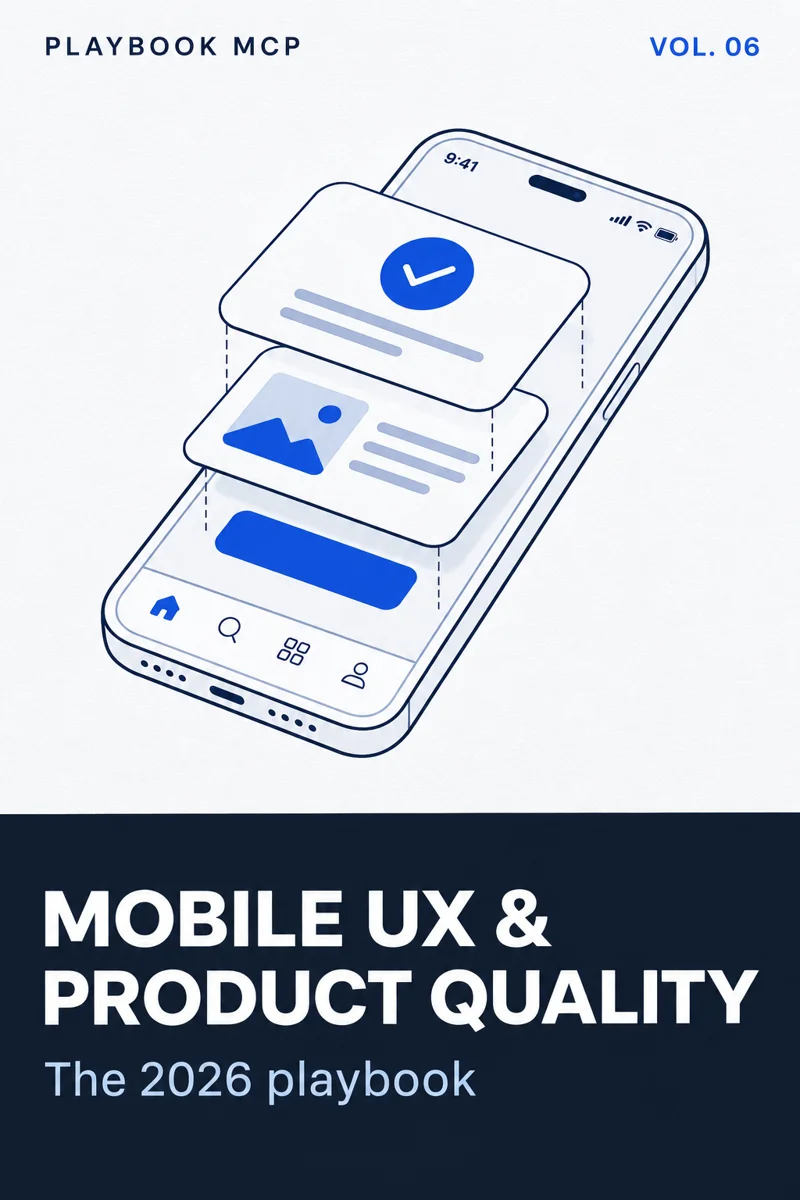
About this playbook
The 2026 playbook
Many apps keep adding features while the core task stays hard to complete. This playbook's central idea is to optimize for finished tasks, not feature count, and it applies that idea across the whole product: research, first use, navigation, states, visual system, motion, accessibility and AI.
It also covers the engineering side of quality: technology choices, offline work and sync, performance budgets measured on real devices, security and account lifecycle, payments, notifications, analytics and testing. It closes with a 90-day plan, a 100-point internal quality review, a release checklist and team templates.
Who it's for
- Founders and product leads who own a mobile app
- Designers and product managers raising quality before a release
- Consultants reviewing client apps for UX and readiness
- Teams deciding whether and how to add AI features
- Studios managing a portfolio of small apps
What you'll be able to do
- Define the first real result a new user should reach, and design onboarding around it
- Handle accounts, permission requests, refusals and pricing without surprises
- Design for states rather than screens, including errors, offline and empty data
- Decide whether a feature needs AI, and evaluate it with a matrix
- Set performance budgets and test on a realistic device and condition matrix
- Keep the store page and the in-app experience consistent
- Score your app with a 100-point internal review and a release checklist
What's inside
Inside this volume
- 01
Main thesis and 2026 directions
Optimize finished tasks, plus platform-specific behavior, adaptive layouts, in-flow AI, on-device processing and surfaces outside the app.
- 02
Lessons from award-winning apps
What recognized apps have in common, and how to read them.
- 03
Research and problem choice
Competitor review that goes beyond screenshots, small repeated research rounds and their outputs.
- 04
First use and activation
The first real result, explaining account requests, permission moments and showing value without fee surprises.
- 05
Navigation, forms, search and states
Home as a task start point, platform back behavior, clear action buttons, forgiving forms and state design.
- 06
Visual system, motion and accessibility
Design tokens, typography, signature moments, motion, sound and haptics, and accessibility as a release condition.
- 07
AI product and engineering contract
Proving the need for AI, recommended AI UX, a model-independent layer and an evaluation matrix.
- 08
Reliability, performance and security
Technology choice, offline and sync, performance budgets, privacy and account lifecycle.
- 09
Revenue, notifications and analytics
Payment experience, re-engagement, an event dictionary and experiment design.
- 10
Store page, testing and release
Matching the store promise, test layers, a device matrix, rollout and recovery.
- 11
Awards, 90-day plan and quality score
How to pursue featuring with the right evidence, a sample plan and a 100-point review.
- 12
Checklists and templates
A release readiness checklist, a feature acceptance contract and usability session templates.
Use it with your AI agent
Ask for the work. Your agent follows the playbook.
Install the Claude skill or connect the MCP with your license key. Then ask in plain language:
- “Review our onboarding against the first-use section and tell me where users meet a permission or fee before seeing value.”
- “Build the state matrix for the checkout screen and list the states the code does not handle yet.”
- “Score this app with the 100-point quality review and give me the three weakest areas.”
Questions
FAQ
Is it for iOS, Android or both?
Both. It recommends keeping one brand while respecting each platform's native behavior.
Does it cover AI features?
Yes. It asks you to prove that AI is needed, then gives UX guidance, an engineering contract and an evaluation matrix, and states that AI does not guarantee commercial success.
Is it only about design?
No. It also covers offline sync, performance, security, payments, analytics, testing and release.
Can it help us get featured by the stores?
It has a section on award and featuring strategy and a case summary template, but it does not promise featuring.
Better together
The Builder's Codex
Design, build, polish and ship apps with AI agents.
$551 $15.80 Save 97%