NewVol. 29 · Published Nov 20, 2026 · Book + Claude skill + MCP
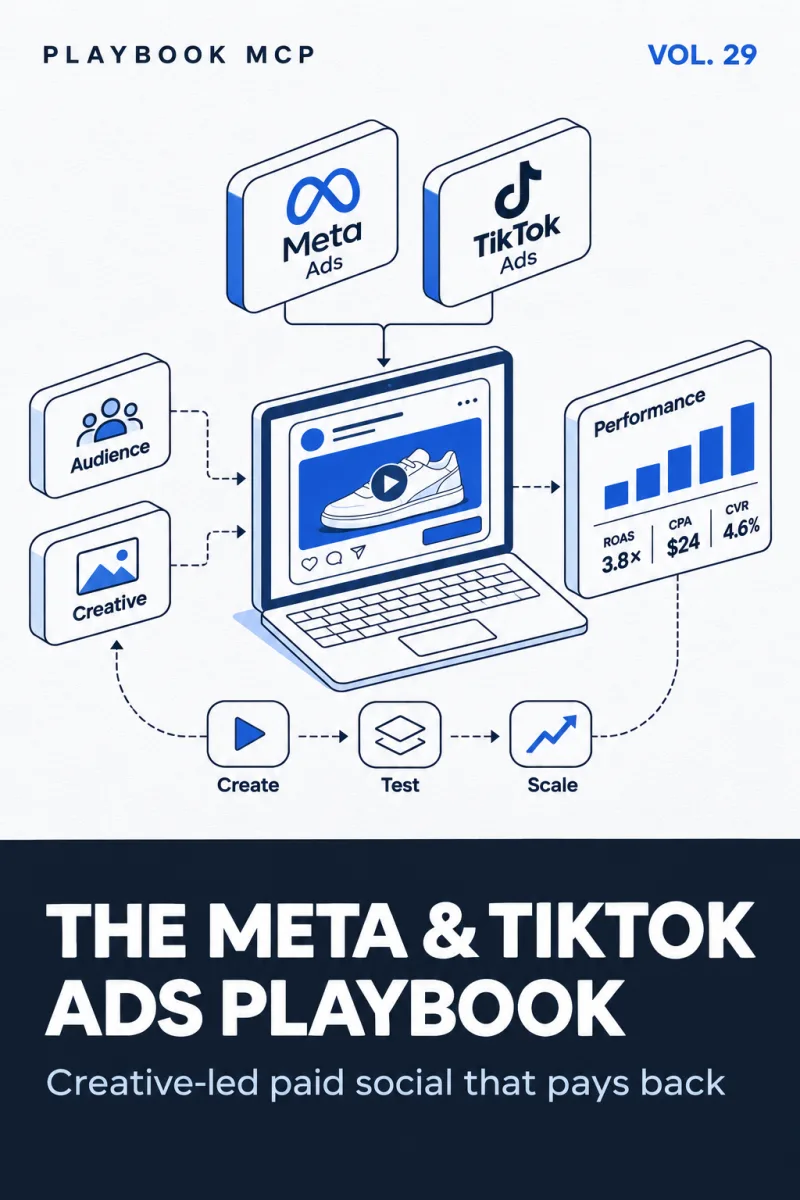
The Meta & TikTok Ads Playbook
Run Meta and TikTok Ads That Pay Back in Contribution Profit, Not Just Platform ROAS
$29 $5.80 Save 80%
Instant digital delivery. About 16k words.
About this playbook
Creative-led paid social that pays back
Most paid social accounts lose money long before the ads run. Nobody wrote the economics down, the tracking double counts, and decisions get made on a ROAS column that ignores margin, returns and customers who would have bought anyway. The Meta & TikTok Ads Playbook puts those foundations first and then runs creative like a production line.
It follows eight steps: set the economics and a stop rule, fix the signal with browser and server events, build a small account skeleton, research angles and claims, produce distinct creative every week, test against written rules, scale in limited steps, and check results against blended and incremental numbers. An AI agent does the analysis and drafting. You approve every decision that spends money.
Who it's for
- Founders and indie developers running Meta or TikTok ads who need the spend to come back as profit
- Marketers and growth leads with budgets from a few thousand to a few hundred thousand dollars a month
- Teams connecting an AI agent to the Meta Ads or TikTok for Business MCP servers who want clear approval gates
- Ecommerce, lead generation and TikTok Shop sellers whose platform numbers don't match the backend
- Anyone adjusting to Advantage+, Smart+ and the 2026 attribution changes
What you'll be able to do
- Calculate contribution margin, break-even CPA and ROAS, target MER and a written stop rule before buying traffic
- Set up Pixel plus Conversions API and Events API with a shared event ID, and prove deduplication with controlled test transactions
- Build one scaling and one testing campaign per platform, with budgets that pass the learning arithmetic
- Build an angle map with at least 12 angles and a claim register, then brief creative using concept, angle, hook and format
- Score every ad on hook rate, hold rate, outbound CTR, cost per result and click-to-result rate, then kill, hold, promote or iterate by rule
- Raise budgets in logged steps with a ceiling, review date and rollback trigger
- Reconcile platform, GA4 and backend numbers, and use quarterly lift tests to calibrate attribution
What's inside
Inside this volume
- 01
Economics and the stop rule
Contribution margin, break-even ROAS, lead-value formulas, MER definitions, separate media, production and learning-loss budgets, and a written stop rule.
- 02
Fixing the signal
A measurement contract, browser and server tracking on both platforms, deduplication, customer parameters, Meta data restrictions, consent, attribution settings and UTMs.
- 03
The account skeleton
Advantage+ scaling and testing campaigns on Meta; Smart+, manual and GMV Max on TikTok; learning arithmetic, bid strategies, a control ledger, naming and defensive rules.
- 04
Message and evidence research
Awareness levels, mining customer language, ad library research without copying, an angle map and a claim register checked against platform and legal rules.
- 05
Creative production at volume
Weekly batch planning, specs and safe zones, hook-first scripts, creator briefs and contracts, partnership and Spark Ads, music rights, and AI content labeling.
- 06
Testing, reading and deciding
Test cards, fixed read dates, five scoring metrics, diagnostic pairs, written kill, hold, promote and iterate rules, and why peeking misleads.
- 07
Scaling, refreshing and validating
Incremental cost checks, stepwise budget increases, fatigue diagnosis, new placements, weekly blended reports, monthly reconciliation and quarterly incrementality tests.
Use it with your AI agent
Ask for the work. Your agent follows the playbook.
Install the Claude skill or connect the MCP with your license key. Then ask in plain language:
- “Using our last 12 months of orders and costs, build the economics sheet with break-even CPA, target and ceiling CPA, MER targets and a stop rule for me to approve.”
- “Audit our Meta Pixel, Conversions API and TikTok Events API setup, list every integration that reports purchases, and write a test plan that proves one deduplicated event per order.”
- “Cluster these reviews and support tickets into problems, objections and triggers, then draft an angle map with claim-risk levels and flag any claim we can't back up.”
- “Pull this week's ad results read-only, score each ad on the five metrics, and propose kill, hold, promote or iterate decisions against our written rules without changing anything.”
Questions
FAQ
Can the AI agent change my campaigns or spend money?
Only if you allow it. The playbook says to connect the agent read-only first, allow writes only after you set platform-side rules or limits, and keep an approval gate on every decision that spends money.
Does it cover TikTok Shop and app campaigns?
Yes, with separate notes. TikTok Shop gets GMV Max guidance and a profit ledger, and app campaigns get a plan that covers App Tracking Transparency and AdAttributionKit. The core workflow is built for website sales and lead generation.
Why not just optimize to platform ROAS?
Platform ROAS counts view-through and repeat purchases and ignores margin, returns, discounts and shipping. The playbook checks every decision against contribution margin, blended MER and periodic incrementality tests.
Is the legal and policy content legal advice?
No. It summarizes platform policies and rules on claims, endorsements, privacy and AI disclosure as practical information, and it tells you to check with the named regulator or a qualified adviser where those rules matter to your business.
How current is it?
It was researched in November 2026 and covers changes such as Meta's March 2026 attribution update and both platforms' MCP servers. Features vary by account and market, so it tells you to check the live interface before you plan around one.
Better together
The Growth Vault
Everything we know about getting users without burning money.
$1,102 $19.80 Save 98%