Vol. 23 · Published Nov 18, 2026 · Book + Claude skill + MCP
The Localization Playbook
Ship Your App and Site in New Languages, Engineered and Reviewed
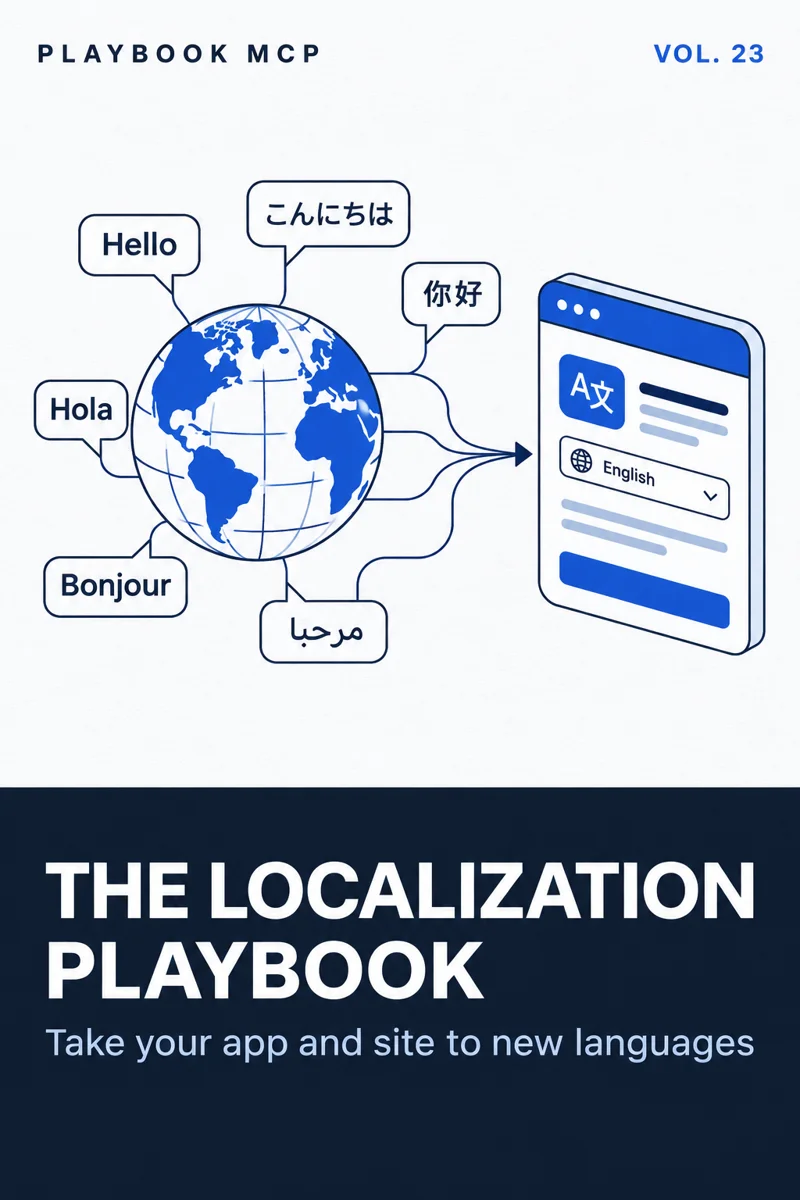
$29 $5.80 Save 80%
Instant digital delivery. About 10k words.
About this playbook
Take your app and site to new languages
Most localization projects fail in predictable ways: hard-coded strings, sentences built from pieces, two-form plurals, hand-formatted dates, layouts that break in long or right-to-left languages, and machine output shipped without review. This playbook puts engineering first and words second, lets your AI agent do the heavy lifting, and keeps a fluent human reviewer in charge of every language you ship.
A ten-step method takes you from a readiness audit and string externalization through locale-aware formatting, choosing markets with evidence, glossaries and style guides, and a five-stage AI-plus-human translation workflow, to store listings, international SEO, locale testing and maintenance. It comes with a main prompt, 15 focused prompts, a full checklist and links to the standards and platform documentation behind the technical claims.
Who it's for
- Founders and product leads with a working app or site in one language
- Developers who need to internationalize an existing codebase without breaking it
- Marketers who want localized store listings and pages that search engines index
- Teams that want an AI agent to extract, draft and validate while people decide
- Experienced professionals moving into AI work who want a repeatable localization process
What you'll be able to do
- Produce a readiness audit with counts, file paths and a prioritized fix list
- Externalize strings with stable keys, translator descriptions and ICU plurals
- Replace hand-formatted dates, numbers and currencies with locale-aware APIs
- Make layouts survive long strings and mirror correctly for right-to-left
- Pick a first wave of two to five locales from a scored, sourced table
- Run AI drafts through automatic validation and in-context human review
- Set up per-language URLs, reciprocal hreflang and localized metadata
- Add pseudo-localization, locale tests and translation checks to CI
What's inside
Inside this volume
- 01
Why localization projects fail
The common failures, from hard-coded strings and concatenation to unreviewed machine output and launch-and-abandon, and what good looks like.
- 02
Before you start
Inputs to gather, decisions you need from the owner on scope, review, pricing and support, and an intake checklist.
- 03
Readiness audit
Inventorying every surface with text and scanning code for literals, manual formatting, plural logic, layout and input assumptions.
- 04
Strings and message format
Choosing a library per stack, semantic keys, translator descriptions, CLDR plural categories, select, and removing concatenation.
- 05
Formatting, layout and right-to-left
Intl and platform formatters, separating locale, currency and time zone, text expansion, logical CSS, bidi text, fonts and language pickers.
- 06
Choosing languages with evidence
Using analytics, store, search and support data, a weighted scoring table, language versus locale, and a small first wave.
- 07
Glossary, style guide and context pack
Approved terms, formality and tone decisions per language, and screenshots and limits linked to string keys.
- 08
The AI-plus-human translation workflow
Five stages: source review, AI draft, automatic validation, human review in context and translation memory.
- 09
Store listings and marketing surfaces
App Store and Google Play metadata, per-locale keyword research, localized screenshots, website pages and emails.
- 10
International SEO
One URL per language, reciprocal hreflang with x-default, self-referencing canonicals, sitemaps and no forced redirects.
- 11
Testing and maintenance
Pseudo-localization, real-locale and time zone tests, IME input, fallbacks, CI checks, source changes and quarterly reviews.
- 12
Prompts, checklist, measurement and sources
A main prompt, 15 focused prompts, a full checklist, per-locale metrics, 17 common mistakes and the documentation behind it all.
Use it with your AI agent
Ask for the work. Your agent follows the playbook.
Install the Claude skill or connect the MCP with your license key. Then ask in plain language:
- “Scan this repository for localization readiness and give me a table of hard-coded strings, concatenation, manual formatting and left/right CSS per surface, with file paths. Do not change code yet.”
- “Translate the billing strings into pt-BR using our glossary and style guide, keep every placeholder and ICU plural intact, return JSON keyed by string ID and list questions for the reviewer.”
- “Add reciprocal hreflang with x-default, self-referencing canonicals and localized titles to our site, replace the IP redirect with a dismissible banner, then crawl the build and report errors.”
Questions
FAQ
Can the AI translate everything for me?
It drafts, validates and flags uncertain strings. Every language you ship has a named fluent reviewer who checks the product on screen and signs off. Legal text needs a qualified professional.
Do I need a translation management system?
No. The playbook names tools such as Crowdin, Lokalise, Phrase, Transifex and Weblate, but a small product can keep resource files, glossary and translation memory in the repository with a script.
Which stacks does it cover?
Web (FormatJS, i18next, Lingui and framework options), iOS String Catalogs, Android resources, Flutter ARB files and ICU on the backend, plus App Store and Google Play listings.
How do I decide which languages to add?
You score candidate locales on demand, market fit, ability to pay, competition, cost and reviewer availability using your own data, and start with two to five. The agent marks unsourced figures as unknown.
What do I get with the playbook?
Each Playbook MCP volume includes the book, a Claude skill that applies it chapter by chapter to your project, and MCP access so your agent can use the method directly.
Better together
The Builder's Codex
Design, build, polish and ship apps with AI agents.
$551 $15.80 Save 97%