NewVol. 46 · Published Nov 26, 2026 · Book + Claude skill + MCP
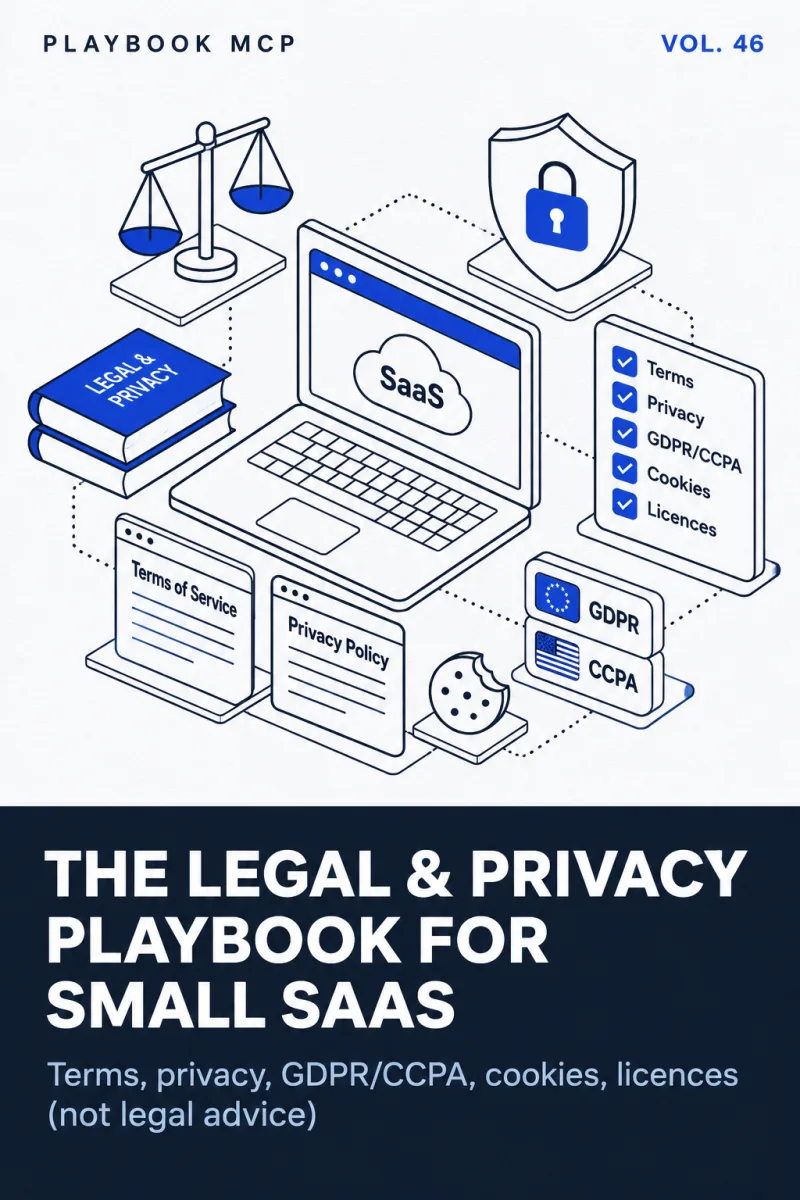
The Legal & Privacy Playbook for Small SaaS
Get Your SaaS Legal and Privacy Work in Order With an AI Agent
$29 $5.80 Save 80%
Instant digital delivery. About 18k words.
About this playbook
Terms, privacy, GDPR/CCPA, cookies, licences (not legal advice)
Many small SaaS products have polished legal pages and a system that does something else. The privacy notice promises deletion, but support exports stay forever. The banner says analytics is optional, but tags fire before anyone chooses. The Legal & Privacy Playbook for Small SaaS closes those gaps by treating every promise as a claim that needs evidence.
It follows eight steps in order. You map which laws apply, inventory your data and vendors, set legal bases and retention, fix cookies, write the privacy notice, DPA and terms from that inventory, control licences and AI features, then keep it all current with a quarterly routine. An AI agent drafts and tests. A named person makes the decisions. This is practical information, not legal advice, and it tells you when to bring in a lawyer.
Who it's for
- Founders and indie developers running a SaaS product in the US, EU or UK without in-house counsel
- Small product teams who need a DPA, subprocessor list and terms before B2B buyers will sign
- Teams whose privacy policy came from a generator or a competitor and no longer matches the product
- Marketers who add tags and pixels and need to know what consent rules apply
- Builders shipping AI features who need to record data flows and disclose AI use
What you'll be able to do
- Build a one-page exposure map showing which regimes apply, in which role, and why
- Build a data map and vendor register from your code, not from memory
- Record one legal basis per purpose, with short legitimate interests assessments and retention rules
- Set up a cookie setup where nothing non-essential runs before consent, refusal is as easy as acceptance, and GPC is honoured
- Write a privacy notice where every sentence traces back to a data-map row, and a DPA that covers each GDPR Article 28(3) item
- Repair terms and subscription flows so renewal terms show before payment and cancellation works online
- Run privacy requests, complaints and breach response from tested runbooks
What's inside
Inside this volume
- 01
The problem and why it matters now
Why legal pages drift away from product behaviour, recent changes in US, EU and UK rules, and the common advice that is out of date.
- 02
Before you start
Inputs, first decisions, when to bring in a specialist early, a product brief and an intake checklist.
- 03
Map your exposure
Trigger questions for each regime, controller and processor roles per purpose, the CCPA calculation, representatives, and focused questions for counsel.
- 04
Inventory and reduce data and vendors
Pulling facts from code, tracing a test marker, the data map, the vendor register and transfer mechanisms.
- 05
Legal bases, risk and retention
One basis per purpose, legitimate interests assessments, consent records, US opt-outs, high-risk screening and retention rules tied to events.
- 06
Cookies and tracking
What regulators check, classifying by purpose, Consent Mode choices, banner rules, GPC and automated consent tests.
- 07
Privacy notice, DPA, terms and subscriptions
A notice skeleton with a traceability test, the Article 28(3) checklist, subprocessor notices, a B2B terms clause list, an AUP and subscription rules.
Use it with your AI agent
Ask for the work. Your agent follows the playbook.
Install the Claude skill or connect the MCP with your license key. Then ask in plain language:
- “Read our app and marketing repos and build a data map and vendor register, marking each fact as observed, reported, proposed or unresolved.”
- “Run a clean-browser Playwright test of our site in no-choice, reject, accept and withdraw states, and list every non-essential request that loads before consent.”
- “Compare our privacy notice with the data map and flag every sentence that has no matching row or makes a promise we cannot prove.”
- “Check our draft DPA against the GDPR Article 28(3) items and our vendors' subprocessor-change notice periods, and list the gaps.”
Questions
FAQ
Is this legal advice?
No. It gives practical information, cites primary sources and dates, and tells you which decisions should go to a qualified lawyer in your jurisdiction.
Which laws does it cover?
Mainly EU and UK GDPR, ePrivacy and PECR, the CCPA and other US state privacy laws, subscription rules such as ROSCA and California's Automatic Renewal Law, CAN-SPAM, and the EU Data Act, DSA and AI Act. It does not cover tax, employment law or sector rules such as HIPAA or PCI DSS.
How long does the first pass take?
The book estimates two to four focused days for a product with one app, one marketing site and 10 to 30 vendors, plus lawyer review time. It notes this is an estimate, not a benchmark.
What access does the AI agent need?
Read access to code repositories, the marketing site, lockfiles, the tag manager export and a vendor list. It does not need production databases, customer exports or confidential legal advice, and tests use synthetic accounts.
We are B2B. Does privacy law still apply to us?
Usually yes. The GDPR protects business contacts as individuals, California's B2B exemptions expired in 2023, and auto-renewal laws protect anyone who qualifies as a consumer.
Better together
The Growth Vault
Everything we know about getting users without burning money.
$1,102 $19.80 Save 98%