NewVol. 32 · Published Nov 26, 2026 · Book + Claude skill + MCP
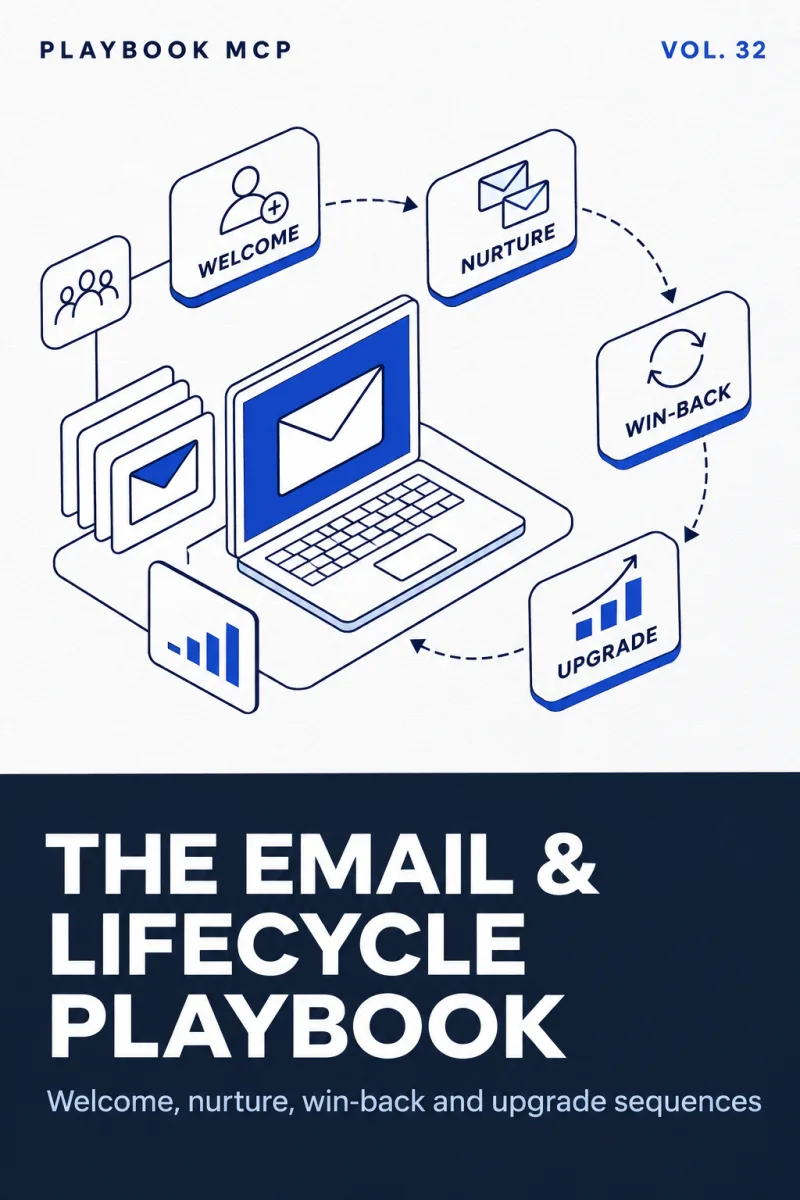
The Email & Lifecycle Playbook
Build Lifecycle Emails That Trigger on Behaviour, Respect Consent and Prove Their Results
$29 $5.80 Save 80%
Instant digital delivery. About 17k words.
About this playbook
Welcome, nurture, win-back and upgrade sequences
Many lifecycle programs start with messages before anyone has defined the customer transitions behind them. Teams copy a seven-email template, call everyone who stopped opening "inactive", offer discounts to people who are missing a feature, and credit every purchase after a click to email. The Email & Lifecycle Playbook starts from the transitions instead: signup to first value, free to paid, failed payment to recovered, lapsed to returning.
You work through it in order. Map the lifecycle, record permission for each market, set up SPF, DKIM, DMARC and one-click unsubscribe, instrument events, suppression and holdouts, and then build welcome, nurture, upgrade, renewal, dunning, win-back and sunset journeys. Each step ends in a deliverable that an AI agent can prepare, and a named person approves it before anything reaches real recipients.
Who it's for
- Founders and indie developers who own the email program for a SaaS product, app or online store
- Product and growth teams whose welcome or upgrade emails keep going out after customers have already converted
- Teams that send at volume and need to meet Gmail, Yahoo and Microsoft sender requirements
- Marketers who sell into the US, UK, EU or Canada and need permission records that hold up when challenged
- Anyone who wants an AI agent to draft segments, copy and configuration but stop for approval before anything goes live
What you'll be able to do
- Draw a one-page lifecycle map where each stage has one entry event, one success event, one metric and one owner
- Pick a provisional activation event from cohort retention data and confirm it later against a holdout
- Classify every message as operational or marketing and record a consent basis per market and signup source
- Set up SPF, DKIM, DMARC alignment and RFC 8058 one-click unsubscribe, then test the full opt-out path
- Write journeys as contracts with entry, exit, re-entry, priority, contact limits and expiry, re-checked before every send
- Build welcome, nurture, upgrade, renewal, dunning, win-back and sunset sequences, each with its own stop conditions
- Measure each sequence by its lift over a random holdout instead of by open rates
What's inside
Inside this volume
- 01
The problem and what good looks like
Common lifecycle failures and their causes, plus the 2024–2026 changes in mailbox enforcement, Apple Mail Privacy Protection, inbox sorting, DMARC standards and law.
- 02
Before you start
A journey brief, the inputs and access you need, the decisions to make up front, a full intake checklist and an open-decisions register.
- 03
Lifecycle map and customer states
How to pick a provisional activation event, a lifecycle map template, and why each state should be stored as a separate fact rather than one status field.
- 04
Permission and message policy
A message register, the consent basis for the US, UK, EU/EEA and Canada, a permission ledger schema, withdrawal handling, tracking pixels and double opt-in.
- 05
Delivery foundation
Sender inventory, Gmail, Yahoo and Microsoft requirements, SPF, DKIM and DMARC rollout under RFC 9989, one-click unsubscribe, warm-up, monitoring and seed tests.
- 06
Events, suppression, holdouts and orchestration
Event contracts, handling duplicate and late events, freshness rules, a single suppression source, holdout groups, journey contracts and the order of dispatch checks.
- 07
Welcome, onboarding and nurture
Onboarding steps that branch on behaviour, with example emails, personalisation fallbacks, accessibility checks, segmented nurture tracks, a message brief and cart-abandonment rules.
Use it with your AI agent
Ask for the work. Your agent follows the playbook.
Install the Claude skill or connect the MCP with your license key. Then ask in plain language:
- “Audit our live automated emails against a lifecycle map and tell me which ones have no clear stage, exit or metric.”
- “Draft a welcome sequence that exits when a user creates their first dashboard, with one call to action per email, and stop for my approval before configuring anything.”
- “Check our sending domains for SPF, DKIM, DMARC alignment and one-click unsubscribe headers, then write a DNS change plan for me to review.”
- “Design a permission ledger and a message register for our US, UK and EU signups, and flag every legal question you cannot answer.”
Questions
FAQ
Will the AI agent send emails or change DNS on its own?
No. The agent prepares segments, copy, configuration and test cases. A named person has to approve audience rules and every production release, and the main prompt blocks sends to real recipients, DNS changes and live automation edits until that person gives an explicit approval.
Is this legal advice?
No. The book summarises rules from primary sources for the US, UK, EU/EEA and Canada as practical information. It tells you to have qualified counsel decide jurisdiction, message classification, consent exceptions and retention.
Why does it say not to rely on open rates?
Apple Mail Privacy Protection loads remote content in the background whether or not someone reads the message, so open data is unreliable. The playbook treats opens and clicks as diagnostic signals and judges each sequence by its effect on a verified outcome compared with a holdout group.
Does it only cover SaaS?
SaaS is the main example, but the book also covers apps, digital products and online stores. Ecommerce variants use a purchase in place of activation and include cart and browse reminders.
I already send email. Where should I start?
Start with the permission and delivery foundation sections anyway. The book notes that many underperforming programs have a consent or deliverability problem hiding under what looks like a copy problem.
Better together
The Growth Vault
Everything we know about getting users without burning money.
$1,102 $19.80 Save 98%