NewVol. 48 · Published Nov 26, 2026 · Book + Claude skill + MCP
The Customer Interview Playbook
Run Customer Interviews That End in a Decision, Not a Deck of Quotes
$29 $5.80 Save 80%
Instant digital delivery. About 15k words.
About this playbook
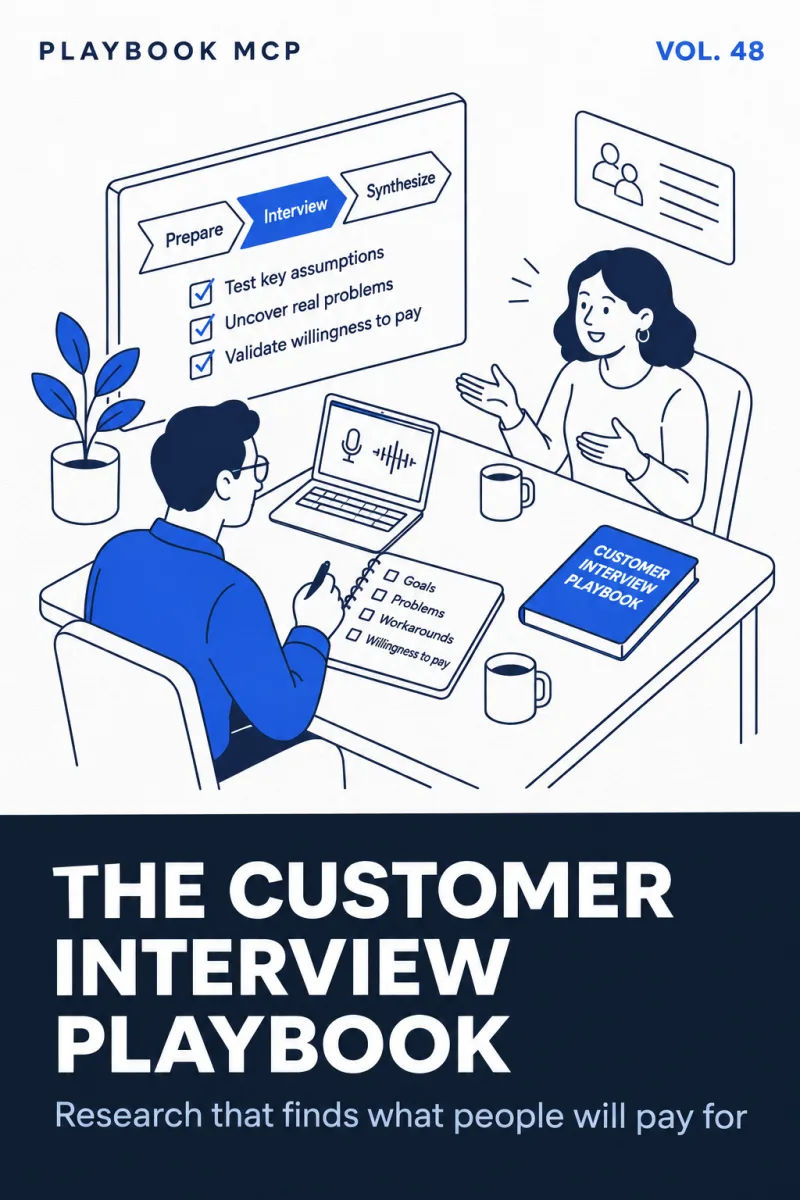
Research that finds what people will pay for
Building software got cheap. The costly mistake now is building something nobody pays for, quickly and well. Interviews are still the cheapest way to find out first, but they mislead when compliments, hypotheticals and convenient participants are treated as proof of demand.
The Customer Interview Playbook turns discovery into a nine-step loop you can finish in two to four weeks: frame the decision, define and recruit the right people, protect participants, run story-based interviews, test commitment and willingness to pay, synthesize the evidence and write a decision memo. An AI agent handles the drafting, sorting and checking. You choose who to talk to, run the conversations and make the call.
Who it's for
- Founders and indie developers who want evidence before they put time and money into a product
- Product and growth teams deciding which segment, problem or price to pursue
- Teams trying to understand why sales stall or why customers leave
- Anyone who wants an AI agent to help with research prep and analysis without inventing evidence
What you'll be able to do
- Write a one-page research brief with ranked assumptions and pass, narrow and kill criteria set before the first interview
- Define participants by recent behavior and buying role, and screen them with a 5–8 question screener that also filters fraud
- Recruit honestly across several channels with fair incentives that never depend on favorable answers
- Set up consent, recording, data retention and AI-tool settings, and check them with a dry run
- Run story-based interviews that focus on past behavior, workarounds and money already spent
- Map the buying system and use a commitment ladder, logging price evidence as paid today, committed or stated
- Synthesize by counting participants rather than mentions, keep a contradiction register and end with a signed decision memo
What's inside
Inside this volume
- 01
Why good conversations produce bad decisions
The wrong sample, leading questions, pitching, stated prices and misused sample-size rules, plus what changed in 2025–2026: AI-assisted participant fraud, notetaker legal risk and synthetic users.
- 02
Frame the decision
A research brief template, an assumption register, decision rules for picking a method, and a comparison of interview lenses: story-based discovery, switch/JTBD, problem validation and willingness to pay.
- 03
Define who to talk to and recruit fairly
Recency windows, a sampling matrix, sample-size guidance from saturation research, a screener template, outreach copy, incentive rules and 2026 fraud checks.
- 04
Protect participants and yourself
Participant information, separate permissions, US recording consent, GDPR basics, AI notetaker settings, EU AI Act disclosure for AI interviewers and a study-level AI processing policy.
- 05
Write, pilot and run the interviews
A 40-minute guide structure, a question rewrite table, switch-force probes, moderation rules, episode timelines, evidence labels and a debrief sheet.
- 06
Test commitment and willingness to pay
Buying-role mapping, a five-rung commitment ladder, rules for honest money asks and preorders, Van Westendorp questions used correctly, and a worked example.
- 07
Synthesize and decide
Case summaries, a codebook, counting participants rather than mentions, mapping evidence to assumptions, and a decision memo that leads to stop, narrow, investigate or a bounded test.
Use it with your AI agent
Ask for the work. Your agent follows the playbook.
Install the Claude skill or connect the MCP with your license key. Then ask in plain language:
- “Draft a one-page research brief for our invoicing idea with ranked assumptions and pass, narrow and kill criteria. Don't contact anyone.”
- “Write a 6-question screener for freelancers who chased a late invoice in the last 60 days, with decoy options and the disqualifiers in a separate key.”
- “Tag these five de-identified transcripts with the codebook, link every claim to its source passage and flag anything you inferred.”
- “Read our interview evidence log and draft a decision memo against the brief's criteria, listing counter-evidence and what would reverse the decision.”
Questions
FAQ
How long does a first interview program take?
About two to four weeks: a few days to frame and recruit, one to two weeks of interviews, and two or three days to synthesize and decide. After that, the playbook turns it into a weekly habit.
How many interviews do I need?
There is no magic number. The playbook suggests planning 8–12 interviews per distinct segment, recruiting in batches and stopping based on the evidence. It explains why the 'five users' rule does not apply to discovery.
Can the AI agent run the interviews for me?
The agent drafts, sorts, counts and checks. You run the conversations. The playbook covers AI-moderated interviews, including disclosure duties, and recommends keeping human-led sessions for unfamiliar problems and high-stakes decisions.
Does it cover asking about price?
Yes. You ask about price after the story, using structured questions and a concrete offer, and you always back it with a commitment test. Every price data point is logged as paid today, committed or stated.
Is the consent and privacy material legal advice?
No. It is practical information with citations on recording consent, GDPR, AI rules and testimonials. For high-risk cases, the playbook tells you to talk to a lawyer.
Better together
The Growth Vault
Everything we know about getting users without burning money.
$1,102 $19.80 Save 98%