Vol. 26 · Published Nov 18, 2026 · Book + Claude skill + MCP
The Customer Acquisition Playbook
Find, Reach and Win Your First 100 Customers, One Channel at a Time
About this playbook
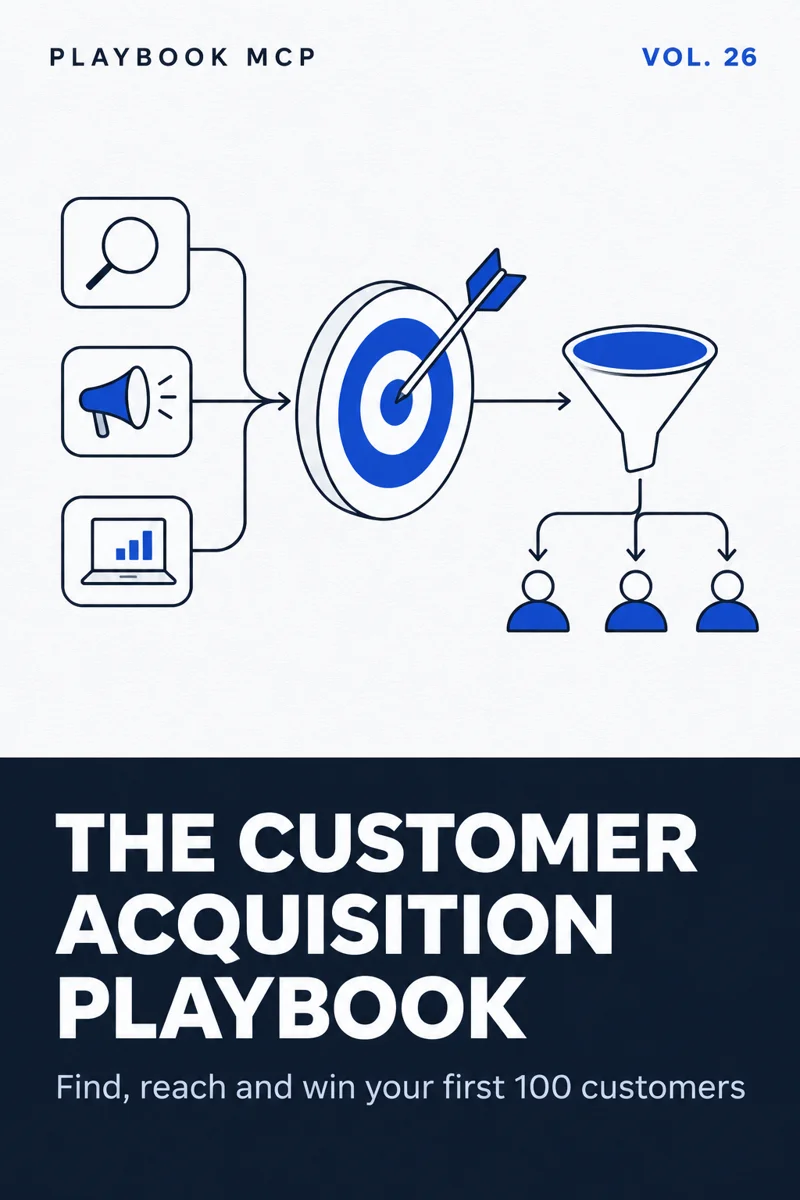
Find, reach and win your first 100 customers
The first 100 customers are a different problem from the next 10,000. You do not need a growth machine yet. You need a short list of the right buyers, an offer they understand, a few channels you can run by hand and a weekly rhythm that shows what is working. This playbook lays that out and lets your AI agent handle research and first drafts while you approve every message.
A ten-step method takes you from ICP and segments through offer and proof, channel scoring, funnel stages and a simple CRM to landing pages, outbound, partnerships, referrals, sales conversations and budgeted tests with stop rules. It covers B2B, B2C and two-sided marketplaces, and it treats every target as a working plan to recalibrate with your own numbers, not an industry average.
Who it's for
- Founders and operators with a working product who need a repeatable way to win early customers
- Consultants and agency owners who sell expertise and want fewer, better-fit clients
- Marketplace builders deciding which side to build first and how to recruit supply
- Experienced professionals who want an AI agent to research and draft while they make the calls
- Small teams spread across too many channels and ready to focus
What you'll be able to do
- Write a one-page ICP with filters, triggers, decision makers and ranked segments
- Turn each segment's offer into a specific promise with a small paid first step
- Score candidate channels and commit to one primary and one secondary
- Define funnel stages with entry criteria and check the math backward from your goal
- Run a simple CRM where every record has a source, a stage and a dated next step
- Run researched outbound with a multi-touch cadence and authenticated email
- Add partner and referral paths that bring in warmer leads
- Give every paid test a budget cap, a metric and a stop rule
What's inside
Inside this volume
- 01
Why early acquisition fails
Selling to everyone, counting the wrong things, funnel math that does not add up, buying traffic too early and leaking trust.
- 02
Intake and the ten-step method
What to gather about offer, buyers, assets and measurement, then each step with what to do, why and when it is done.
- 03
ICP and segments
Filters, triggers, problem, decision makers and alternatives, segment ranking, and readiness gates for two-sided marketplaces.
- 04
Offer and proof
Specific promises, small first steps, relevant proof, trust details, answers to buyer fears and clear service packages.
- 05
Choosing channels
A scoring sheet for twelve channels, how to read it, and how B2B and B2C motions differ in practice.
- 06
Funnel stages and a simple CRM
Stage definitions with entry criteria, backward funnel math, required CRM fields and source tracking rules.
- 07
Landing points
A six-part page structure, a short first form, using two domains consistently and outcome-based marketplace pages.
- 08
Outbound
Activity-based list sources, A/B/C tiers, sourced research, a first message template, a cadence and deliverability basics.
- 09
Inbound, partnerships, marketplaces and referrals
High-intent inbound paths, picking and pitching partners, platform profiles, and referral asks that are specific.
- 10
Sales conversations and follow-up
A six-part call structure, same-day recaps, scheduled follow-ups, handling no and building an objection library.
- 11
Test budgets and the weekly rhythm
Hypotheses, caps, stop and scale rules, what to postpone, a weekly schedule and a 30/60/90-day plan.
- 12
AI agents, prompts, checklist and measurement
Rules for agent use, a main prompt and fifteen focused prompts, a full checklist, stage metrics and sources.
Use it with your AI agent
Ask for the work. Your agent follows the playbook.
Install the Claude skill or connect the MCP with your license key. Then ask in plain language:
- “From this CRM export, find what our best customers have in common and propose an ICP with three segments ranked by pain, reach, proof and deal speed.”
- “Build a list of 50 companies matching our ICP filters, tier them A, B and C, and write a research brief with a sourced reason to contact each A-tier account.”
- “Review our website as a careful buyer in our top segment and list every trust leak with the exact text, the page and a fix.”
Questions
FAQ
Is this for B2B or B2C?
Both. The playbook compares the two motions directly and also covers two-sided marketplaces, including which side to build first and when to open the other.
Do I need an ad budget?
No. It starts with warm introductions, outbound and partners, and treats paid channels as tests with a budget cap and stop rule once the offer, page and tracking work.
Will the agent send outreach for me?
No. The agent researches, drafts and summarizes with a source link for every fact. A human approves every message, and automated posting is ruled out.
Does it give conversion benchmarks?
No. It asks you to label assumptions, set baselines from your first month and improve against your own numbers rather than other companies' averages.
What do I get with Playbook MCP?
Each volume includes the book, a Claude skill that applies it chapter by chapter to your business, and MCP access so your agent can use the playbook while it works.
Better together
The Growth Vault
Everything we know about getting users without burning money.
$1,102 $19.80 Save 98%