NewVol. 40 · Published Nov 26, 2026 · Book + Claude skill + MCP
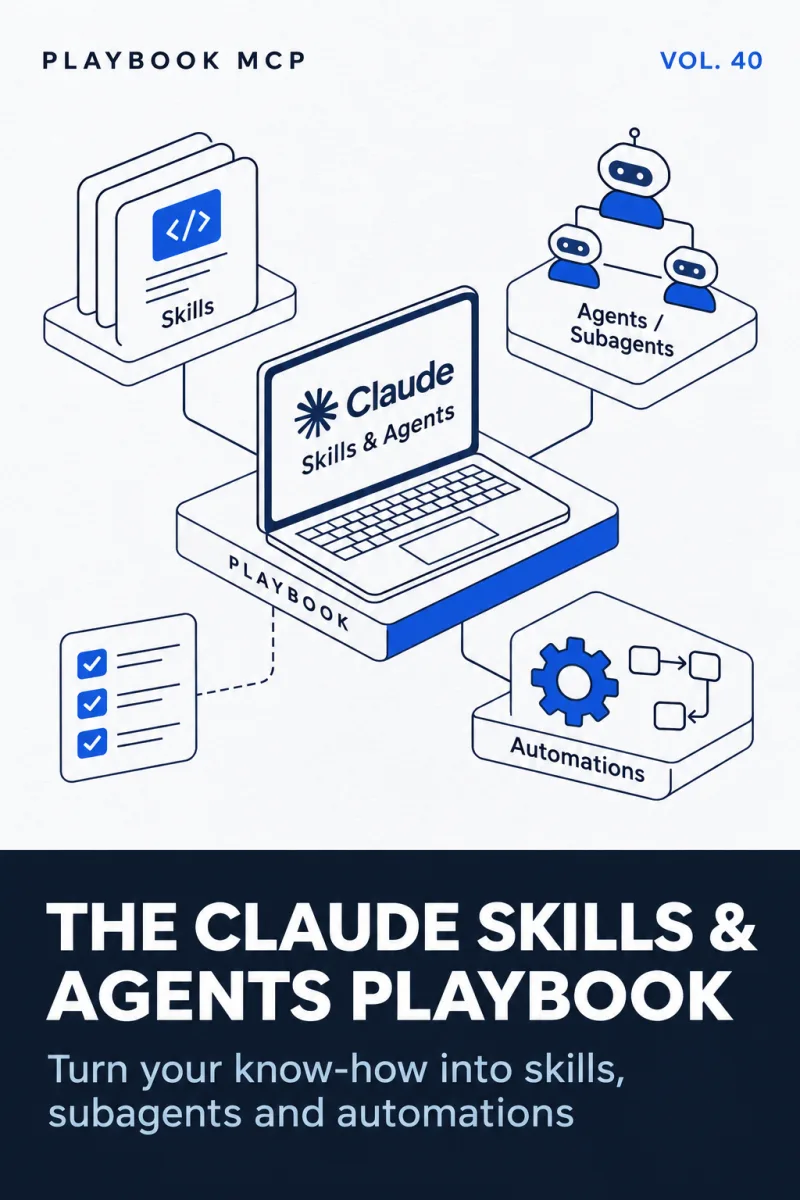
The Claude Skills & Agents Playbook
Turn Your Know-How Into Claude Skills, Subagents and Automations You Can Trust
$29 $5.80 Save 80%
Instant digital delivery. About 15k words.
About this playbook
Turn your know-how into skills, subagents and automations
Most people who try to automate expert work with Claude end up supervising it instead. Every session starts with a fresh explanation, the same corrections get made each week, and rules written into a prompt get ignored at the worst moment. The Claude Skills & Agents Playbook replaces that with an eight-step method: capture one recurring process, put each piece in the right container, and prove it works before you rely on it.
You start with a task contract and evals written before any skill text. Then you build a short, well-described skill, hand bounded work to subagents only when evals show it helps, and enforce hard rules with permission rules, hooks and narrow credentials. After that you run it on a schedule or in CI with run records and a human review gate, and ship it as a versioned plugin. A worked example of a fictional analytics consultancy, templates and a main agent prompt come with it.
Who it's for
- Founders and operators who repeat the same expert work every week and want Claude to do it their way
- Developers building skills, subagents and hooks in Claude Code for themselves or their team
- Product and growth teams that want recurring reports, reviews or audits to run reliably
- Specialists who want to capture their rules and checklists without losing human judgment
- Anyone who installs third-party skills and needs a way to review them as untrusted code
What you'll be able to do
- Score your recurring processes and pick the right first one to capture
- Write a task contract with statuses, escalation rules and a decision table
- Decide whether each rule belongs in CLAUDE.md, a skill, a subagent, a hook, a permission rule or a connector
- Build trigger and outcome evals and compare the skill against a no-skill baseline
- Write a SKILL.md with a sharp description, a short body, reference files and exact scripts
- Design read-only subagents with tool allowlists, delegation contracts and defined return formats
- Enforce must-never rules with deny rules, blocking hooks and narrow credentials, and test them against prompt injection
- Run skills unattended with claude -p, GitHub Actions or scheduled tasks, with run state, caps and a human gate
What's inside
Inside this volume
- 01
The problem and the building blocks
What skills, subagents, hooks, permission rules, connectors, runners and plugins each do, and the common reasons captured know-how fails.
- 02
Before you start
Roles, access, up-front decisions, a capability record and a full intake checklist, plus when to stop intake.
- 03
The eight-step method
Harvest, choose the container, write evals, author, delegate, guard, automate and maintain, each with a clear done-when gate.
- 04
Harvest the know-how and choose the container
A scoring table, extraction questions, a task contract, a decision table and a map of where each piece of the brief belongs.
- 05
Evals first, then the skill
Trigger and outcome evals, four case groups, grader choices, and SKILL.md frontmatter, body rules, scripts and install tests.
- 06
Subagents and guardrails
When a subagent pays off, delegation contracts, a read-only checker template, and five layers from permission rules and hooks to skill supply-chain review.
- 07
Automation with explicit state
Choosing a runner, scripted runs, a GitHub Actions template, a run-state machine, persisted run records and the human approval gate.
Use it with your AI agent
Ask for the work. Your agent follows the playbook.
Install the Claude skill or connect the MCP with your license key. Then ask in plain language:
- “Help me score the processes I repeat each month, pick one, and write a task contract and decision table for it.”
- “Write trigger and outcome evals for my weekly report skill, then run them with and without the skill and show me the results.”
- “Add permission deny rules and a PreToolUse hook that block reads of .env and any curl call, then try to break them and report what happened.”
- “Audit this third-party skill folder before I install it: read every file, list network calls and hooks, and tell me what it can do.”
Questions
FAQ
Do I need to be a developer to use this?
You need to be comfortable running Claude Code in a git repository. The method starts with ordinary recurring work such as reports, reviews or triage, and the templates show the files you will create.
Does it only work with Claude Code?
The examples use Claude Code, but the method also applies to claude.ai, the Claude API, the Claude Agent SDK and other hosts that support Agent Skills. The book notes that permissions, tools and scheduling differ between these surfaces.
Why not just write the rules into the skill?
The playbook treats instructions as requests. Anything that must hold every time belongs in a permission rule, a blocking hook or a credential restriction, and the book shows how to set these up and test them.
Should I build a multi-agent system?
Usually not at first. The book recommends starting with one skill and adding a subagent only when your evals show that isolated context or an independent check improves results enough to justify the extra cost.
Is it safe to install skills from marketplaces?
The book advises treating any skill you did not write as untrusted code. It gives a review procedure: read every file, search for network calls and hidden instructions, check runtime fetches and hooks, and pin a version.

Better together
The Builder's Codex
Design, build, polish and ship apps with AI agents.
$551 $15.80 Save 97%