Vol. 10 · Published Nov 17, 2026 · Book + Claude skill + MCP
The Autonomous Builder
Let AI Agents Ship and Polish Your App Without Losing Control
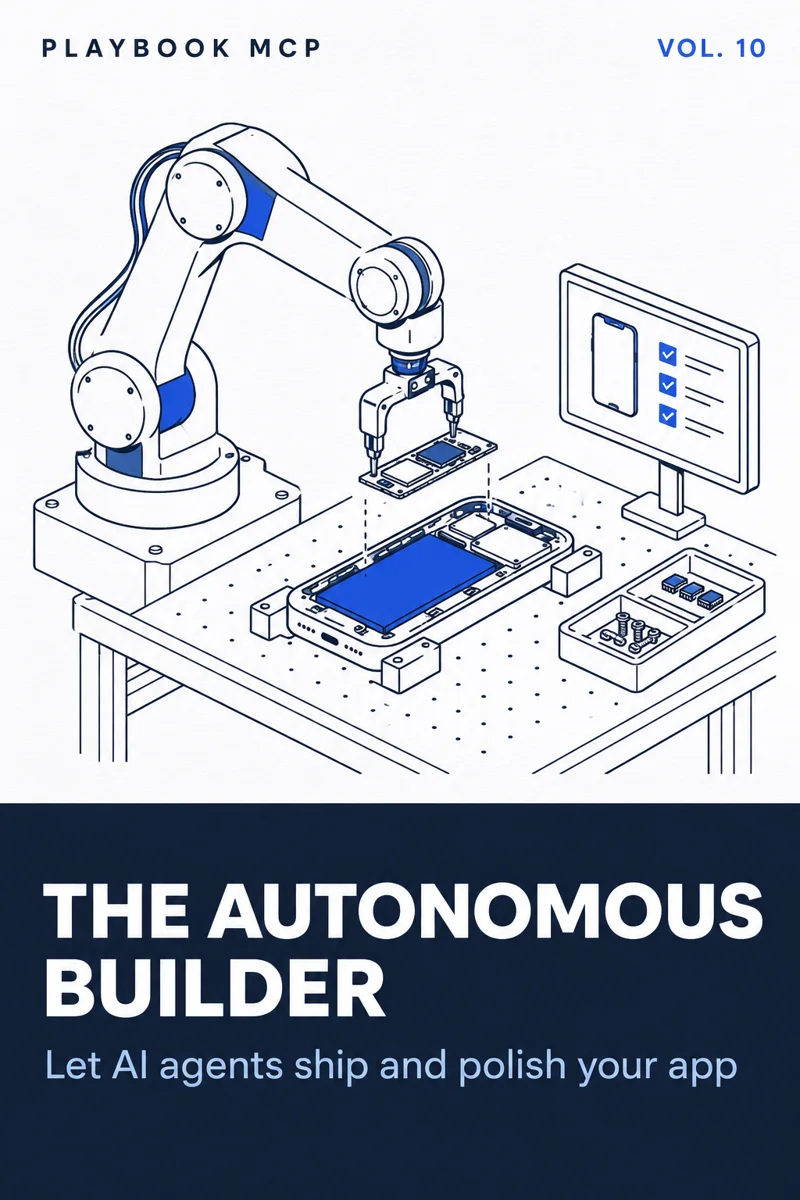
About this playbook
Let AI agents ship and polish your app
Coding agents can keep working on an app for hours, but without structure they drift: features pile up, quality varies and nobody can tell what changed. This playbook gives the agent a master set of operating instructions, a short product contract and an iteration loop where each change has evidence.
It sets a UX standard where every screen has to earn its place, defines restrained mobile polish, and splits the work into Builder, Critic and QA roles. Persistent repository state, an external supervisor for automatic restarts with a stop flag and budget, store release readiness and a ready bootstrap prompt make it practical.
Who it's for
- Founders building mobile apps with Claude Code or similar agents
- Product people who want agent work held to a clear standard
- Developers setting up long-running or repeated agent sessions
- Small studios polishing several apps at once
What you'll be able to do
- Write a concise product contract the agent works from
- Run an iteration loop that ends each cycle with a report
- Add polish such as feedback, haptics and transitions without slowing the app
- Check product completeness and performance with a matrix
- Separate Builder, Critic and QA so the agent reviews its own work honestly
- Keep state in the repo so work resumes cleanly across sessions
- Set up a supervisor that restarts work until you say stop, within a budget
- Prepare for App Store and Play Store release
What's inside
Inside this volume
- 01
Master operating instructions
The base rules the coding agent follows.
- 02
Discovery and product contract
Understand the project and user problem, then write a short contract.
- 03
Autonomous iteration loop
How each cycle picks, builds, checks and records one change.
- 04
UX standard and mobile polish
Every screen must earn its place, and polish means responsiveness, not constant animation.
- 05
Completeness, performance and testing
A product completeness matrix, technical quality and tests across realistic journeys.
- 06
Builder, Critic and QA roles
Independent roles and a scorecard backed by evidence.
- 07
Metrics and ethical growth
Product metrics without manipulative patterns.
- 08
Persistent state and auto-retrigger
Repository state files and a supervisor with a stop flag, budget and repo lock.
- 09
Release readiness and reporting
Store readiness checks and an end-of-iteration report template.
- 10
Bootstrap prompt and final principles
A ready-to-paste prompt that starts the agent on your repo.
Use it with your AI agent
Ask for the work. Your agent follows the playbook.
Install the Claude skill or connect the MCP with your license key. Then ask in plain language:
- “Read this repo, write the product contract and start the first iteration on the weakest screen.”
- “Act as the Critic: score the last iteration against the scorecard and list what the Builder should fix.”
- “Check the app against the store release readiness section and report what blocks submission.”
Questions
FAQ
Can the agent really run without me?
It can resume work across sessions through an external supervisor you set up, with a stop flag and budget that you control.
Which frameworks does it support?
It is framework-neutral and applies to native or cross-platform mobile apps.
How is quality checked?
Through separate Builder, Critic and QA roles, a scorecard with evidence and tests across realistic user journeys.
Is this a long book?
No. It is a compact operating guide of 18 sections, written to be pasted into an agent's context and used every day.
Better together
The Builder's Codex
Design, build, polish and ship apps with AI agents.
$551 $15.80 Save 97%