NewVol. 45 · Published Nov 26, 2026 · Book + Claude skill + MCP
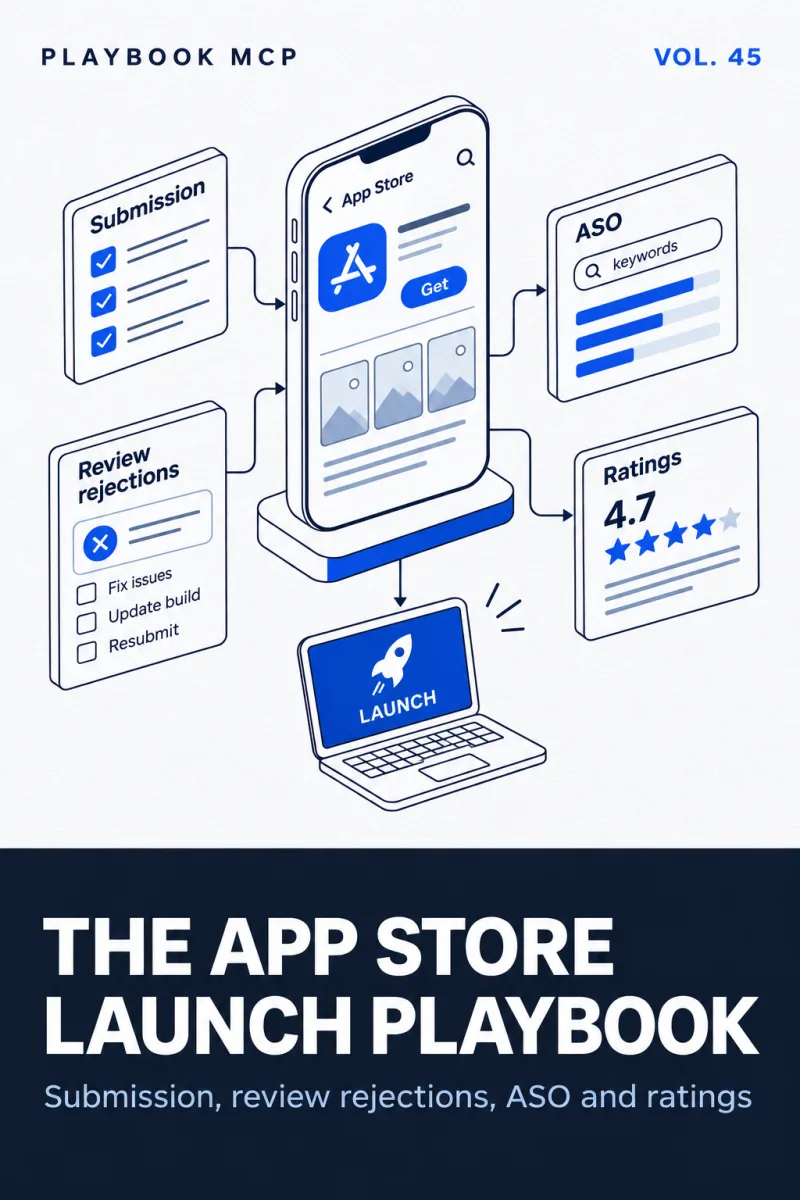
The App Store Launch Playbook
Launch Your iOS and Android App With Fewer Review Cycles and Fewer Surprises
$29 $5.80 Save 80%
Instant digital delivery. About 15k words.
About this playbook
Submission, review rejections, ASO and ratings
Most app launches slip for reasons you could have predicted: an expired demo account, an IAP the reviewer can't find, privacy answers filled in from memory, or a Google Play account that still needs its closed test. The App Store Launch Playbook treats a store launch as a release process with evidence, owners and decision gates.
It walks you through eight steps in order: define the launch contract, run a compliance pre-flight, qualify the release build, build a truthful and searchable listing, submit and resolve findings, release in a controlled way, test the listing, and run a compliant ratings loop. Every rule links to its Apple or Google source, and each step comes with templates and prompts you can give an AI agent.
Who it's for
- Founders and indie developers shipping a first iOS or Android app
- Teams whose app was rejected and who want a structured way to resolve the finding
- Product managers who own a release and need clear gates and owners
- Growth leads responsible for the store listing, keywords and screenshots
- Anyone using an AI agent to prepare store submissions who wants it kept within safe limits
What you'll be able to do
- Build a launch dossier that shows what you are releasing, which rules apply and what evidence shows you are ready
- Map each feature to the relevant Apple guideline and Google Play policy before you submit
- Audit SDK data flows so privacy labels and Data safety answers match the shipped app
- Choose a payment route for each storefront, including the US external purchase option
- Test the distributable build on physical devices across purchase, restore, deletion and offline cases
- Write review notes, clarifications and appeals that resolve findings without wasted resubmissions
- Release with manual release, phased release and staged rollout, then verify public availability
- Write a keyword plan and screenshot sequence that stays within field limits and metadata rules
What's inside
Inside this volume
- 01
Launch contract and gates
Scope, owners, three separate dates, blocker definitions and concrete approval records for submission and publication.
- 02
Compliance pre-flight
A feature-by-rule table covering login, account deletion, social login, third-party AI consent, payments, UGC and tracking, plus a data-flow audit template.
- 03
Qualify the release build
Current SDK and target API floors, an eight-step device test, a journey test matrix, Android vitals thresholds and the Google closed-test timeline.
- 04
A truthful, searchable listing
Field limits, iOS keyword rules, a research procedure, an intent map, screenshot structure and asset specs for both stores.
- 05
Submit and resolve review findings
Review notes template, finding classification, clarify, correct or appeal decisions, reply templates and common rejection fixes.
- 06
Controlled release
Manual and phased release on iOS, staged rollout on Play, rollout gates, recovery planning and a launch-day runbook.
- 07
Listing experiments
Apple product page optimization and Google Play experiments, with an experiment contract and a test protocol.
Use it with your AI agent
Ask for the work. Your agent follows the playbook.
Install the Claude skill or connect the MCP with your license key. Then ask in plain language:
- “Go through this repo and its dependency manifests, list every feature and SDK, and map each one to the Apple guideline and Google Play policy that applies, with the evidence we still need.”
- “Check our Android bundle for target SDK, the Play Billing version it actually resolves and 16 KB page support, and report what fails.”
- “Draft App Review notes for build 1.0.0 using our test accounts and core journey, and flag anything a reviewer could not reach.”
- “We got a Guideline 2.1 rejection. Classify the finding, tell me how to reproduce it, and draft either a clarification or a correction reply.”
Questions
FAQ
Does it cover both the App Store and Google Play?
Yes. It covers Apple's App Store and Google Play, mainly for phones and tablets. Other device families, alternative distribution, regulated products and children's apps need extra policy work, and the book tells you to identify those early.
How current are the rules in the book?
It reflects sources available on 22 November 2026, including Xcode 26, target API 36 and recent payment changes. Every rule links to its source, and the book tells you to check the live policy page and your console before you submit.
Will it help me get more ratings?
Yes, but only through compliant methods: the system rating prompt shown after a defined success moment, weekly review replies and fixes for recurring complaints. It rules out bought reviews, incentives and review gating.
Can an AI agent submit my app for me?
The playbook gives an agent read access for preparation work and says it should not submit builds, reply to reviews or change live metadata without your approval, because those actions are public.
Is this legal advice on payments?
No. It describes what Apple and Google publish about payment routes per storefront and tells you to consult a qualified lawyer or accountant before changing how you take money.
Better together
The Builder's Codex
Design, build, polish and ship apps with AI agents.
$551 $15.80 Save 97%