NewVol. 47 · Published Nov 26, 2026 · Book + Claude skill + MCP
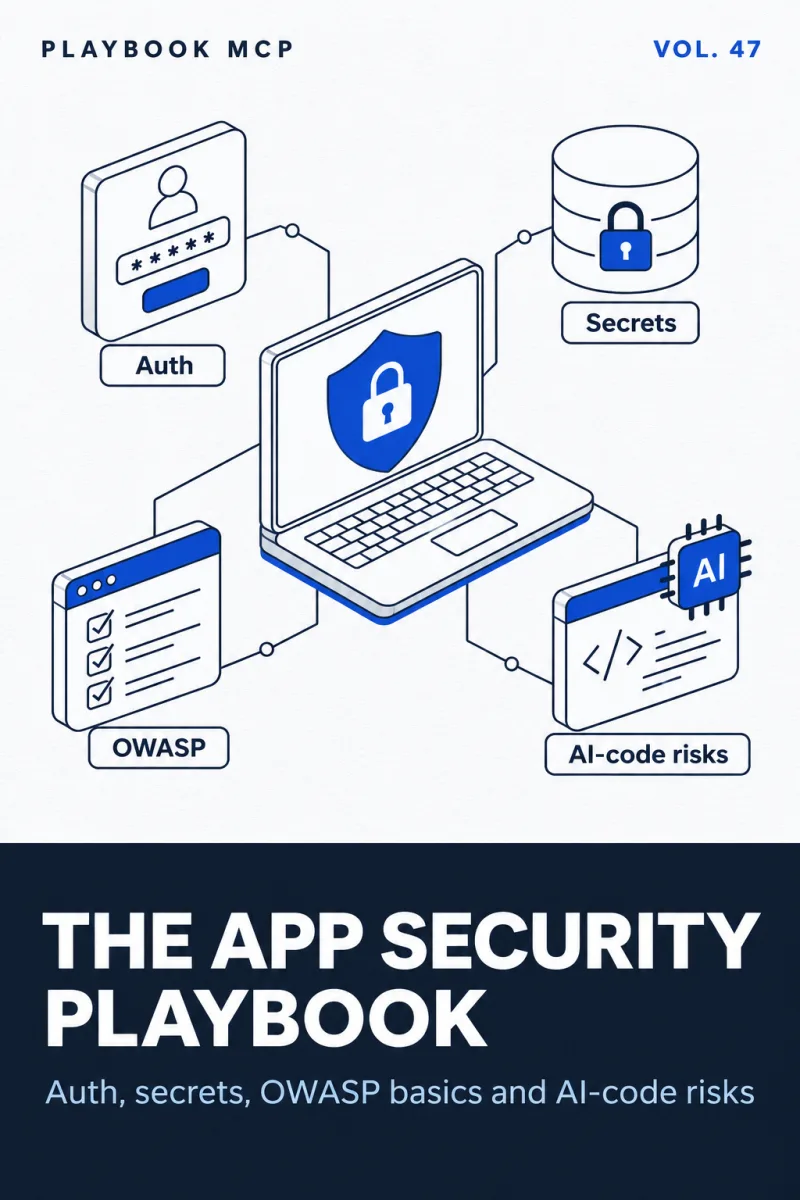
The App Security Playbook
Close the Security Gaps That Most Often Break Small Apps, With Proof for Every Control
$29 $5.80 Save 80%
Instant digital delivery. About 17k words.
About this playbook
Auth, secrets, OWASP basics and AI-code risks
Most small teams ship without a security team, and more and more of their code is written by AI agents that confidently repeat insecure patterns. The App Security Playbook is a working method, not a reference manual: you apply it to one real app and one named release, and you finish with deliverables you can show.
It follows eight ordered steps. You map routes, data and trust boundaries. You make authentication boring and strong, enforce authorization on the server and in the database, and get secrets out of code. Then you close the OWASP basics, secure the supply chain, put AI agents and AI features under written rules, and set up detection and incident response. A control only counts when a test, a configuration check or observed behavior proves that it works.
Who it's for
- Founders who ship web or mobile apps without a full-time security team
- Developers building with Claude Code, Cursor, Codex or AI app builders who want guardrails on agent-written code
- Product leads who must decide whether a release is safe to ship and accept the remaining risk
- Teams on Supabase, Firebase or similar stacks where the client talks to the database directly
- Small SaaS teams preparing for customer security questions, incidents or new reporting duties
What you'll be able to do
- Build a route inventory, data map and threat register from code and deploy config, not from memory
- Set password, passkey, MFA, recovery and session rules that match NIST SP 800-63B-4 and RFC 9700
- Write cross-user and cross-tenant tests that prove one user cannot reach another's data, side effects included
- Enable and test Row Level Security or Firebase rules on every client-reachable table
- Scan the full git history for secrets, revoke anything that leaked and rehearse key rotation
- Lock dependencies, add a release-age cooldown, harden CI permissions and publish with OIDC
- Keep AI coding agents and AI features inside enforced limits, with an incident runbook and a tested restore
What's inside
Inside this volume
- 01
The problem and what changed in 2025–2026
Why exploitation, supply-chain attacks and AI-written code change the picture, plus the updates to OWASP Top 10:2025, ASVS 5.0, NIST 800-63B-4 and npm publishing.
- 02
Before you start
Owners, scope, data classes, legal footprint, fix-time targets, an intake checklist and a written testing boundary.
- 03
The eight-step method
Each step with what to do, why it matters and a checkable 'done when' state, from mapping the app to detection and recovery.
- 04
Authentication and authorization
Buying instead of building auth, password and passkey rules, account recovery, hardened sessions, deny-by-default policies, RLS examples and cross-user test code.
- 05
Secrets out of code
A metadata-only secrets inventory, full-history scanning, revoke-first cleanup, push protection, least-privilege keys and a rotation runbook.
- 06
OWASP basics
Injection, CSRF and CORS, security headers, SSRF, uploads, webhooks, cost limits and fail-closed error handling, each tied to a test.
- 07
Supply chain, release, AI and operations
Lockfiles, cooldowns, install scripts, CI hardening, trusted publishing, vulnerability triage in context, release evidence, AI agent rules and incident response.
Use it with your AI agent
Ask for the work. Your agent follows the playbook.
Install the Claude skill or connect the MCP with your license key. Then ask in plain language:
- “Use the App Security Playbook. Run Step 1 only on this repository: list every route, server action, webhook and job, mark each public, authenticated or admin, and stop at the approval gate.”
- “Check every table in our Supabase public schema for Row Level Security, flag missing with check clauses, and write cross-user tests for each route that takes an object ID.”
- “Scan the full git history and our MCP config files for secrets with Gitleaks, list what you find as metadata only, and draft a rotation runbook for each live key.”
- “Review our GitHub Actions workflows: pin actions to commit SHAs, cut permissions to the minimum and move npm publishing to OIDC trusted publishing.”
Questions
FAQ
Is this a penetration test or a compliance certification?
No. It gives practical security guidance and a method to apply it, but it is not a penetration test, a compliance certification or legal advice. It tells you when to confirm legal duties with a regulator or lawyer.
Do I need to buy security tools first?
No. The book says not to start by buying a scanner. You start by writing down what the app must protect and which actions it must refuse. The tools it uses, such as Gitleaks, TruffleHog and Dependabot, come in at specific steps.
How long does a first pass take?
The playbook's own estimate is two to four focused working days for a typical app with one web front end, one API and one database, then about two hours a month for the routine. It says these are guidance, not a benchmark.
Is it safe to let an AI agent run this on my code?
The book tells you to keep the agent in a branch, give it synthetic test data and only the access the current chapter needs, review every change and never give it production credentials. It runs one step at a time and stops at approval gates.
Does it cover Supabase and Firebase apps?
Yes. It treats every client-reachable table as a public API until rules prove otherwise, includes RLS policy examples and a query that finds tables without RLS, and covers Firebase Security Rules and App Check.
Better together
The Growth Vault
Everything we know about getting users without burning money.
$1,102 $19.80 Save 98%