NewVol. 53 · Published Nov 26, 2026 · Book + Claude skill + MCP
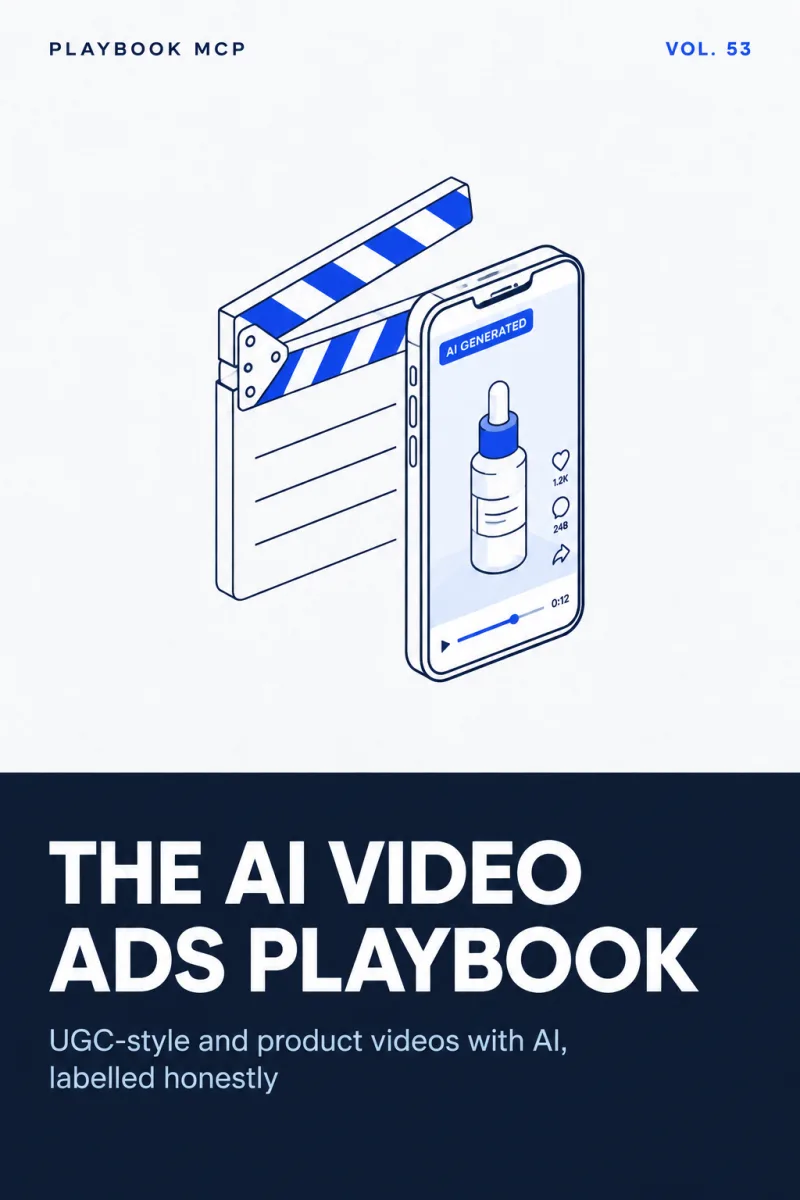
The AI Video Ads Playbook
Make AI Video Ads That Sell Without Faking Customers or Results
$29 $5.80 Save 80%
Instant digital delivery. About 16k words.
About this playbook
UGC-style and product videos with AI, labelled honestly
AI tools can now produce a UGC-style ad in minutes. They can just as quickly produce a synthetic customer who never bought anything, a generated demo of a product doing what it can't, or a label that no viewer will see. The AI Video Ads Playbook shows founders and small teams how to use these tools for paid video without inventing evidence, breaking platform rules or losing control of costs.
It follows a nine-step method with approval gates: define the buying decision, build a claims file, choose the honesty model for each format, secure rights and consent, write distinct concepts, produce controlled assets, then edit, label, test and measure. Each ad ends up with a claims file, a consent and rights record, a disclosure record and a test plan behind it. Prompts, a pre-launch checklist and source-linked platform and legal rules are included.
Who it's for
- Founders and indie developers who want to make paid video ads with AI tools
- Growth and product marketers running UGC-style creative on Meta, TikTok or YouTube
- Small creative teams using avatars, AI voices or generated B-roll for clients
- Anyone who needs a clear record of how each AI-assisted ad was made, approved and labelled
- Teams using an AI agent to draft briefs, scripts and review forms under human sign-off
What you'll be able to do
- Write a one-page brief that gives each ad a specific buying decision and a cost ceiling
- Build a claims file that covers spoken words, demonstrations, context and editing, with evidence for each claim
- Decide who appears to be speaking in each format and what disclosure that requires
- Record specific, written consent for faces, voices, replicas, music and stock
- Write four to six concepts that are actually different, not near-copies the platform treats as one creative
- Keep product footage real while using AI for settings, presenters and narration
- Apply on-screen labels, platform AI settings and provenance metadata, then check the final render
- Launch a structured test with a written decision rule instead of picking winners on clicks
What's inside
Inside this volume
- 01
The problem and the rules that tightened
Why convincing AI footage creates false evidence, and a summary of FTC, US state, EU AI Act, UK and platform rules checked in November 2026.
- 02
Before you start
The commercial, evidence, production and measurement packages, an intake checklist and stop conditions.
- 03
Claims file and proof order
A claims template with status for each claim, decision rules for visuals, health, ratings and offers, and an order of preference for proving how a product works.
- 04
Honesty model and consent
Disclosure needs for real customers, paid creators, founders, synthetic presenters, digital replicas and voiceovers, plus consent and asset rights records.
- 05
Concepts, scripts and controlled production
Concept cards, a five-dimension variety score, script and storyboard templates, tool evaluation by cost per accepted asset, and a shot log.
- 06
Edit, label, localise and verify
Four labelling layers, safe zones, muted and audio-only checks, localisation of meaning and a 14-point review form for each ad.
- 07
Testing, prompts, checklist and mistakes
Test cards that separate exploration from controlled experiments, agent prompts, a pre-launch checklist, measurement guidance and the most costly mistakes.
Use it with your AI agent
Ask for the work. Your agent follows the playbook.
Install the Claude skill or connect the MCP with your license key. Then ask in plain language:
- “Draft a one-page brief and a claims file for our refillable spray, and mark every claim as approved, conditional, needs evidence or blocked.”
- “Write five distinct ad concepts for our SaaS onboarding, score each on persona, problem, format, setting and angle, and flag any pair that is too similar.”
- “Review this script for a synthetic presenter and remove any line that gives the avatar personal experience, a biography or a claim missing from the claims file.”
- “Fill in the review form for this final render, check that the disclosure sits inside the safe zone in the first 3 seconds, and list what I still need to verify by hand.”
Questions
FAQ
Does it tell me not to use AI avatars?
No. Synthetic presenters can host, explain features and walk through demos. The playbook says they must be labelled on screen and must never be presented as a real customer or claim personal experience.
Can AI generate the product footage?
Not for showing the product working. Shots of the product in use, its results or a working interface should be real footage or accurate renders you can prove. AI is used for settings, B-roll, presenters and voice.
Which platforms does it cover?
Meta, TikTok, Google Ads and YouTube, including their AI label settings, safe zones and related ad policies, with sources to recheck before launch.
Is this legal advice?
No. It summarises platform and regulatory sources as practical guidance. For synthetic likenesses, regulated products and disputed rights, it recommends a review by a qualified lawyer in the relevant jurisdiction.
Can my AI agent run the whole campaign?
The agent can draft briefs, claims files, scripts and review forms. The method requires your sign-off at each gate, and the agent should not generate final video, publish or spend money without your approval.
Better together
The Growth Vault
Everything we know about getting users without burning money.
$1,102 $19.80 Save 98%