NewVol. 49 · Published Nov 26, 2026 · Book + Claude skill + MCP
The AI Customer Support Playbook
Let an AI Agent Answer Customers Without Losing Their Trust
$29 $5.80 Save 80%
Instant digital delivery. About 16k words.
About this playbook
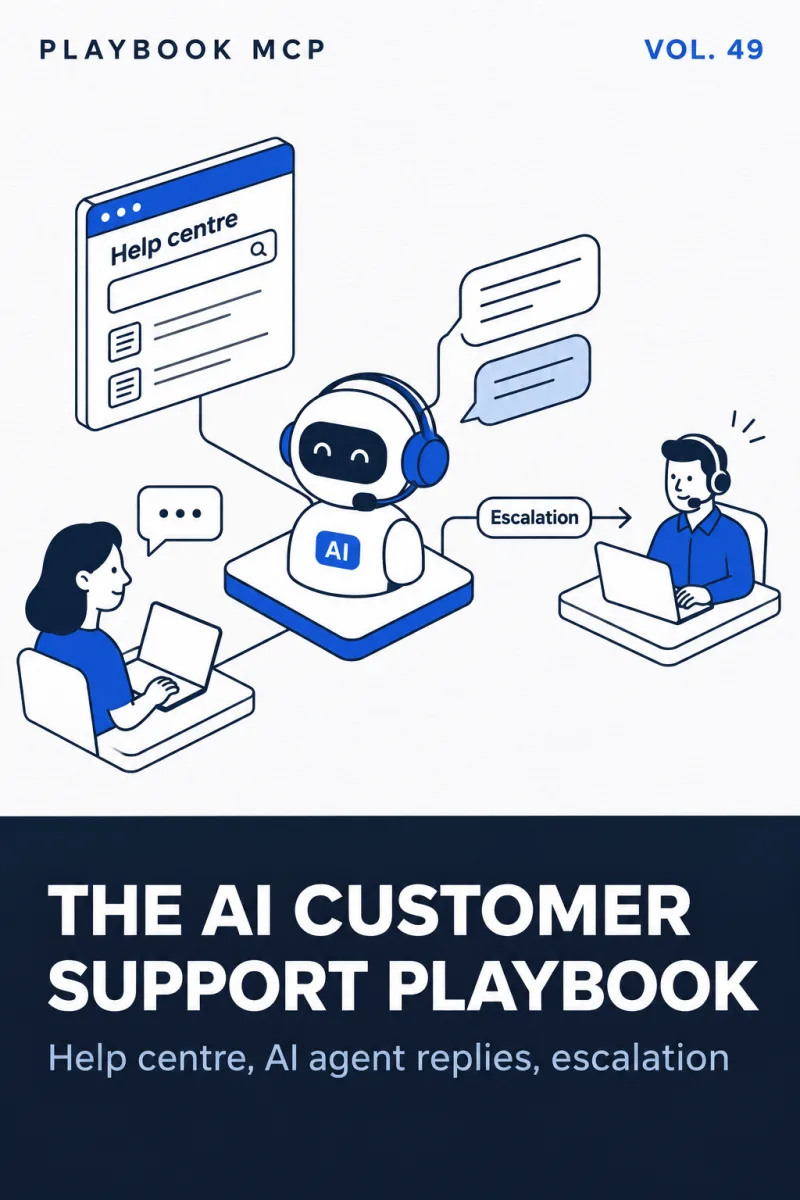
Help centre, AI agent replies, escalation
Many AI support launches run in the wrong order: buy a tool, switch it on, then discover the help centre contradicts the real policy. The bot repeats the mistake with confidence, customers can't reach a person, and nobody can say whether anyone was actually helped.
The AI Customer Support Playbook gives you an eight-step method in a fixed order: demand, policy, content, answers, actions, escalation, testing, launch. Each step produces an artefact the next one depends on, with four approval gates an agent must not skip. It comes with risk tiers, an agent policy template, system instructions, tool contracts, a handoff packet, focused prompts and a sign-off checklist.
Who it's for
- Founders and indie developers who want an AI agent answering customers without risking refunds, accounts or legal standing
- Support leads who need a clear boundary between what the AI answers, does, drafts or hands off
- Product and growth people responsible for the help centre and support metrics
- Teams evaluating AI agent vendors who need their own definition of a resolution
- Builders wiring an AI agent to billing, account or MCP tools who want permissions enforced outside the model
What you'll be able to do
- Map past conversations into customer intents and choose a narrow, eligible first scope
- Assign each intent a risk tier and one of four modes: answer, act, assist or hand off
- Write an agent policy with red zones, data rules and AI disclosure that fits EU, UK and US rules
- Turn the help centre into one correct, owned, tested article per question
- Configure grounded answers that cite sources and abstain when content is missing
- Connect narrow tools with identity checks, confirmations, idempotency and result verification
- Build escalation on every channel with a handoff packet so customers never repeat themselves
- Measure verified resolution instead of silence, and fix each failure at its cause
What's inside
Inside this volume
- 01
The problem and why it matters now
The separate jobs an AI support system does, recent disclosure and human-route laws, cases like Moffatt v. Air Canada, and how vendors define an outcome differently.
- 02
Before you start
An intake checklist covering conversation exports, policies, systems, named owners and a vendor-neutral deployment record.
- 03
Map demand and set the boundary
Intent classification, R0–R3 risk tiers, a hard eligibility gate, a policy register and an agent policy document with identity and access levels.
- 04
Help centre as the source of truth
An article standard and template, contradiction checks, review rhythm, accessibility, and how to prepare content and metadata for retrieval.
- 05
Grounded answers
Build-or-buy guidance, answerability rules, grounding rules, a full system instructions template and example customer copy.
- 06
Safe actions
Narrow tools, a tool contract, separating proposal from approval and execution, retries, prompt injection defences and MCP authorization.
- 07
Escalation and handoff
Triggers, a structured handoff packet, handoff states and failure recovery, time targets and warm, cold, approval and takeover modes.
Use it with your AI agent
Ask for the work. Your agent follows the playbook.
Install the Claude skill or connect the MCP with your license key. Then ask in plain language:
- “Classify this 90-day ticket export into customer intents, size each by volume and handle time, and propose a risk tier for each.”
- “Compare every help centre article that states a price, limit or deadline against our approved refund and billing policy, and list the contradictions.”
- “Draft system instructions for our support agent that require sources, abstain when content is missing, and disclose it is AI in the first message.”
- “Write a tool contract for update_billing_email with identity checks, confirmation, duplicate protection and audit fields, then list the tests it must pass.”
Questions
FAQ
Does it tie me to one AI support vendor?
No. It works whether you buy an agent such as Fin or Zendesk AI agents or build one on a model API. You own the content, policy, tests and metrics either way.
Will the AI be allowed to issue refunds?
By default, no. Money, access and data-loss requests stay in Assist mode, where a human approves. If you automate later, limits are enforced in code, not in the prompt.
Does it cover AI disclosure laws?
It summarises the EU AI Act Article 50, Utah, Maine and California rules and gives one disclosure design that meets all of them. It is practical information, not legal advice.
How do I know if customers were actually helped?
The playbook separates verified resolution from contained or silent conversations and has you compare AI-handled and human-handled cases on the same quality measures.
Where should a small team start?
With one product, one channel and a small set of low-risk intents, expanding only after you can explain why the first deployment works.
Better together
The Growth Vault
Everything we know about getting users without burning money.
$1,102 $19.80 Save 98%