NewVol. 41 · Published Nov 26, 2026 · Book + Claude skill + MCP
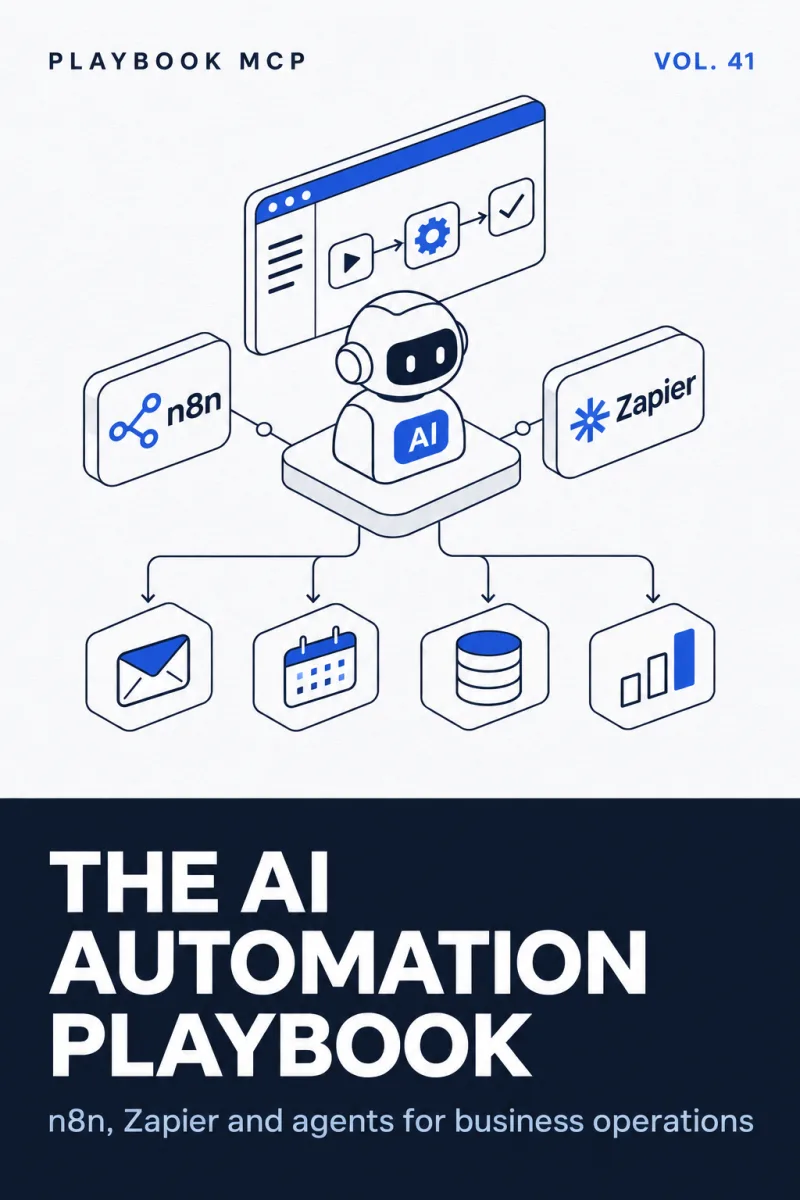
The AI Automation Playbook
Automate Real Business Processes With n8n, Zapier and AI Agents, Safely
$29 $5.80 Save 80%
Instant digital delivery. About 15k words.
About this playbook
n8n, Zapier and agents for business operations
Most automation demos start with a clean input and end with a nice output. Real operations bring duplicate webhooks, missing permissions, changing records and approvers who are away. The AI Automation Playbook is a method for building automations that update the right record exactly once, under the right policy, and tell someone when they fail.
It works in nine steps. You pick and size one process, write its contract, set the autonomy level for each step, choose the platform, set access and data boundaries, build a deterministic skeleton, add guarded AI steps and approvals, evaluate and launch with controls, then run it as a maintained system. Templates, decision tables, a SQL operation ledger, an approval packet and platform notes for n8n and Zapier are included.
Who it's for
- Founders and operations leaders who want to automate recurring work without creating fragile or unsafe systems
- Indie developers building n8n or Zapier workflows that include model steps or agents
- Product, growth and ops people who need to choose between Zapier, n8n Cloud, self-hosted n8n, Make or custom code
- Teams that give AI agents tool access and need least-privilege permissions and human approval gates
- Anyone who needs to show net time saved, not just minutes saved
What you'll be able to do
- Score candidate processes and choose the one most likely to pay back, with a recorded baseline
- Write a one-page process contract with field-level rules that doubles as your test oracle
- Assign one of five autonomy levels to each step, from plain rule to autonomous agent
- Model platform cost at 1x and 3x volume across tasks, executions, credits and reviewer time
- Build idempotent writes, atomic deduplication, bounded retries and an error path that actually alerts
- Add AI steps with schemas, abstention, scoped tools and approvals bound to the exact proposal
- Test against a golden dataset, launch in stages and keep each automation under a keep, change or retire review
What's inside
Inside this volume
- 01
Select and size the process
A seven-criterion scorecard, a priority formula, rejection rules and a baseline, plus a net value formula that subtracts review, exceptions and maintenance.
- 02
Specify the process contract
A one-page spec template and policy decision tables covering triggers, eligible cases, permitted actions, exceptions and a field-level definition of correct.
- 03
Choose the autonomy level, step by step
A five-level ladder from rule to autonomous agent, workflow patterns to try first and how to settle the agent versus workflow question by experiment.
- 04
Choose platform and hosting
An evaluation worksheet, a comparison of Zapier, n8n, Make and custom code, licence notes, a cost model and minimums for self-hosting n8n.
- 05
Access, data boundaries and version records
Access registers, field allowlists, retention per store, prompt-injection defences, MCP checks and denial tests.
- 06
Build the deterministic skeleton
Trigger authentication, an event envelope, an operation ledger with atomic claims, idempotency keys, retry rules, reconciliation and platform-specific error handling notes.
- 07
AI steps, approvals, evaluation and launch
Model task contracts, a validated JSON schema, a tool permission matrix, approval packets with timeout rules, golden datasets and controlled release.
Use it with your AI agent
Ask for the work. Your agent follows the playbook.
Install the Claude skill or connect the MCP with your license key. Then ask in plain language:
- “Apply section 4.1 of the AI Automation Playbook to these eight recurring tasks, score them and recommend one with a baseline plan.”
- “Write a process contract for our quote-request email triage, including a decision table, exception queues and a field-level definition of correct.”
- “Review this n8n workflow for idempotency and silent failures: check the On Error settings, deduplication and whether the error workflow can fire.”
- “Draft a tool permission matrix and approval policy for an agent that reads our CRM and drafts customer replies, with every send gated by a person.”
Questions
FAQ
Does it cover both n8n and Zapier?
Yes. It gives platform-specific notes for n8n and Zapier, including error handling, approvals and billing, and compares them with Make and custom code so you can choose by the controls you need.
Will it push me to use AI agents everywhere?
No. The rule is deterministic first, AI second and agents last. Each step runs at the lowest autonomy level that works, and agents need a way to verify their results.
How does it handle actions that send, pay or delete?
Those actions are gated, limited or reversible. Permissions and limits are kept outside the model, and approvals are tied to the exact proposal and checked again before the action runs.
Is this legal advice on GDPR or the EU AI Act?
No. It gives practical information on data protection and AI rules and tells you when to involve qualified counsel, especially for decisions that significantly affect people.
Can I run it with an AI agent?
Yes. You can install the volume's skill or connect the Playbook MCP server and ask your agent to apply one section at a time, starting in a sandbox without production credentials.
Better together
The Builder's Codex
Design, build, polish and ship apps with AI agents.
$551 $15.80 Save 97%