NewVol. 33 · Published Nov 22, 2026 · Book + Claude skill + MCP
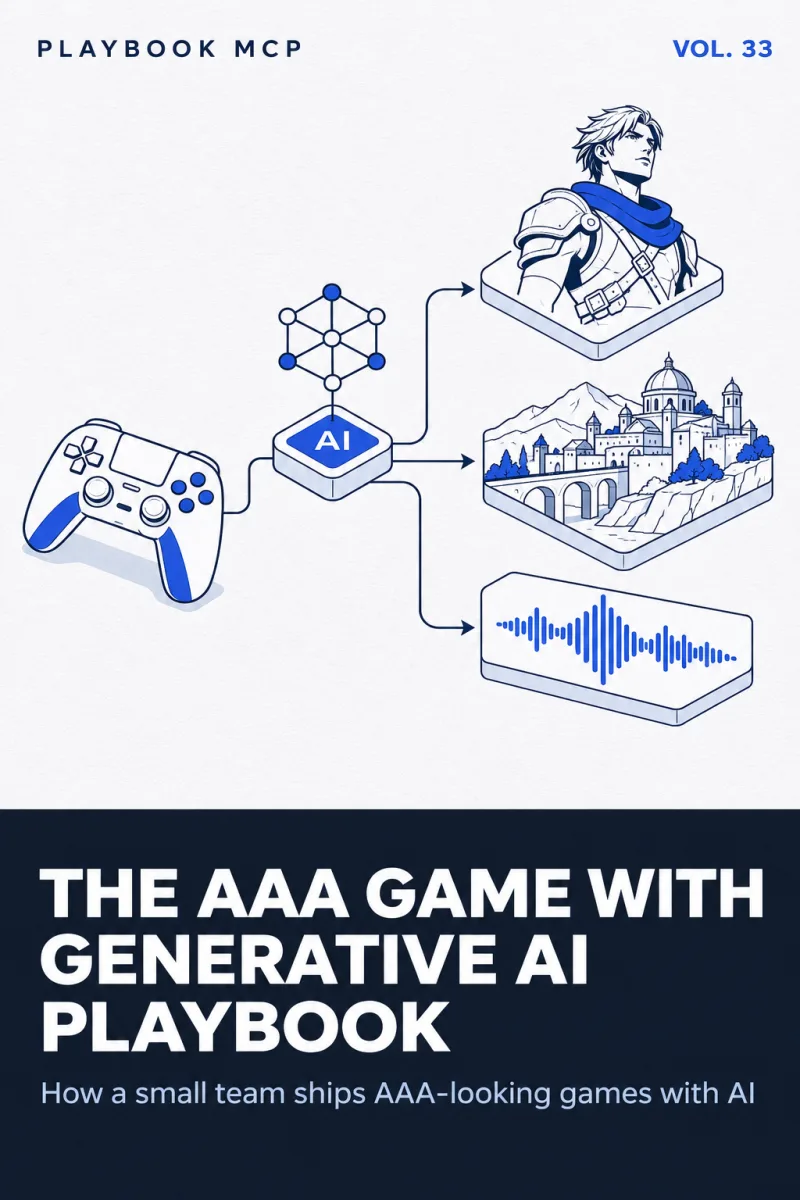
The Aaa Game with Generative AI Playbook
Ship a Game That Looks Bigger Than Your Team, With AI You Can Defend
$29 $5.80 Save 80%
Instant digital delivery. About 16k words.
About this playbook
How a small team ships AAA-looking games with AI
Generating a concept image or a textured mesh now takes minutes. Turning it into a consistent, licensed asset that works in the game is still slow and expensive. Many teams find this out too late, after they have built a pile of mismatched assets they cannot ship or disclose honestly.
This playbook gives teams of roughly 2 to 15 people a nine-step method that goes from a production contract and art bible to a style lock, one proven asset path, a vertical slice and controlled batches. Every visible or audible asset gets a provenance ledger entry, so you can write your Steam AI disclosure from records instead of guesses.
Who it's for
- Indie founders and small studios who want a high-end visual result on a limited surface area
- Technical artists building concept-to-engine pipelines for images, 3D, animation and audio
- Producers who need scope, hours and milestone gates that match the team's real capacity
- Experienced developers who want to use generative AI without licence, performer or platform surprises
- Teams that run coding agents and want them to work in small, gated, evidenced steps
What you'll be able to do
- Write a production contract with a counted content list, an AI role per asset class and stop conditions
- Build an art bible with measurable rules, do/don't pairs and an anchored review rubric
- Turn that bible into a style lock: reference sets, fixed prompt blocks and pinned model versions
- Take one representative asset from concept through retopology, materials and export to a packaged build, and record its true cost
- Handle animation, voice and music with written performer consent and recorded licences
- Keep a provenance ledger and licence register for every shipped asset
- Write an accurate Steam AI disclosure and keep AI placeholders out of release builds
What's inside
Inside this volume
- 01
The problem: cheap candidates, expensive games
Why generation speed hides finishing costs, what changed in tools and rules, and the failures that sink small teams.
- 02
Contract the experience and lock scope
Player loop, technical targets, a counted content list with AI roles, three tiers of attention and pre-ranked cuts.
- 03
Rights, provenance and tool permissions
Four rights questions per asset, a provenance ledger template, a licence register, provider terms to check and the placeholder rule.
- 04
Art bible and style lock
Measurable art rules, review scenes, a scoring rubric, then reusable prompt blocks, reference sets and pinned models.
- 05
Prove one complete asset path
2D and 3D pipelines from concept to packaged build: retopology, UVs, PBR channels, budgets, LODs and an interchange test asset.
- 06
Characters, motion, voice and music
Motion specs, retargeting checks, a voice line database, consent contract checklists and adaptive music requirements.
- 07
Vertical slice, scaling and shipping
Engine integration contracts, controlled batches, Steam disclosure written from the ledger, real store assets and release evidence.
Use it with your AI agent
Ask for the work. Your agent follows the playbook.
Install the Claude skill or connect the MCP with your license key. Then ask in plain language:
- “Draft a production contract and counted content list for our game, with an AI role and hours-to-final estimate for each asset class.”
- “Build a provenance ledger CSV from our asset folder and flag every player-facing file missing a model version, licence or approver.”
- “Scan the release build for any TMP_ placeholder references and list where each one is used.”
- “Write our Steam AI disclosure from asset-ledger.csv in plain, specific sentences, and list anything you could not confirm.”
Questions
FAQ
Does "AAA-looking" mean matching a big publisher's output?
No. The book defines it narrowly: selected environments, characters, lighting, animation and presentation that meet a strong visual reference at the intended camera distance on the target hardware. It does not mean matching publisher content volume.
Which engines does it cover?
It gives guidance for Unreal, Unity and Godot. That includes pinning an exact version and renderer and testing import and reimport behaviour in each engine.
Will it help with Steam's AI disclosure?
Yes. It shows how to keep a provenance ledger for every player-facing asset and write the disclosure from it. It also covers how to keep AI placeholders out of shipped builds.
Is this legal advice?
No. It gives practical production guidance on copyright, contracts, performer rights and AI regulation, with sources. It tells you to check primary sources and talk to a qualified lawyer for decisions that matter.
Can my AI agent run the whole pipeline on its own?
No. The book says to give the agent one deliverable at a time with evidence and a stop at each gate. Publishing, performer consent, licensing and destructive changes stay with named humans.
Better together
The Game Maker's Grimoire
Design, make and launch games with AI.
$261 $9.80 Save 96%